


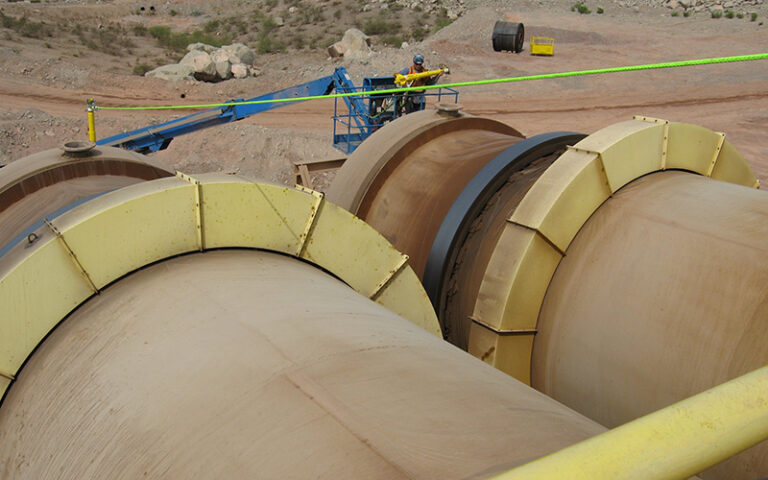
The agglomeration drum occupies a critical position in the heap leach flowsheet, but rarely receives the operational attention commanded by the leach pad itself. Yet, when the agglomerator goes down, the entire operation can grind to a halt.
With copper demand projected to outpace supply through the 2030s, and the technique increasingly being applied to additional metals, heap leaching has emerged as the go-to method for extracting metals from low-grade and complex ore bodies and tailings.
As new projects advance across the American Southwest, Latin America, and beyond, and existing operations look to push throughput to levels their original designs never anticipated, agglomeration drum reliability and uptime has gone far beyond a maintenance concern, extending into production strategy.
Where Agglomeration Drums Are Used (And How That’s Changing)
As the world faces the rise of more complex ore bodies and the decline of high-grade ore sources, the industry is increasingly adopting the heap leaching technique across metallic ores.
Copper is the dominant heap leaching application by volume and installed base globally. The copper heap leach model, in which ore is crushed, agglomerated with dilute sulfuric acid, stacked, leached, and processed via SX-EW, is one of the most mature hydrometallurgical flowsheets, with major operations across the world running agglomeration drums for decades.

Interior view of agglomeration drum at copper heap leaching facility
Heap leaching is also widely used in the gold industry, as well as in uranium mining. With uranium demand on the rise, the industry is seeing renewed interest in previously dormant operations, as well as new construction.
Beyond these more well-established applications, heap leaching is also increasingly being applied in less conventional settings, including those processing nickel, zinc, rare earths, and in at least one case, lithium.
Why Agglomeration Drum Maintenance Is Non-Negotiable
Heap leaching depends on uniform, predictable percolation of the leachate through the heap. In working with complex ore bodies, or when particle size varies or clay fines are present, agglomeration yields a more uniform particle size distribution where fines are bound up to prevent clogging the space between particles, ensuring maximum heap permeability.
While agglomeration drums are engineered for this high-capacity, demanding application, even the most robustly built drum will underperform or eventually fail without proper maintenance. As site managers continue to demand more from their operations, a strategic and comprehensive maintenance plan is the foundation of maximizing uptime.
Key Maintenance Strategies for Heap Leaching Ore Drums
Rotary Drum Inspections: The Foundation of Longevity
Arguably the most effective (and least costly) aspect of maintenance is a comprehensive inspection program. A strategic inspection schedule helps operators and maintenance personnel to detect subtle changes in the equipment over time that might otherwise go unnoticed. Inspections are thus critical to detecting and mitigating early signs of wear to prevent escalation into larger issues.
A properly structured inspection program should be tailored to the site’s unique operating conditions, with pre-determined intervals and component checklists, as well as thorough documentation. This generally includes protocols for daily, weekly, monthly, and quarterly inspections that follow a systematic review of all components.
In addition to reviewing mechanical components, operators and maintenance personnel should also monitor and track key rotary drum measurements, such as drum float, cold gap, tire and trunnion diameters, etc.
Beyond inspections by on-site personnel, rotary drums should also receive an annual inspection by the OEM or other qualified drum service provider. This type of inspection provides a more in-depth assessment of the drum’s mechanical condition, establishing benchmark data, identifying potential issues, and prioritizing maintenance procedures for planning purposes.
The importance of thorough inspections and data keeping cannot be overstated; operators who defer inspections to maintenance windows often discover compounding damage that could have been prevented if identified earlier.
Shell and Liner Wear: Know Your Ore
Shell wear is the most material-specific maintenance consideration in agglomeration drum operation, with ore and leachate chemistry having a significant influence on the processing environment. Copper oxide ores processed with sulfuric acid, for example, create a highly corrosive environment. When chlorides are present, this corrosion effect is amplified.
In contrast, gold operations using cement binders tend to see more abrasive, less corrosive wear patterns.
Rubber liners are the standard approach to protecting the drum shell’s interior. Regular inspection of liner integrity should include visual examination of seams and edges where acid could infiltrate the connection to the shell. Any bubbling, lifting, or discoloration warrants immediate attention; continued operation with a compromised liner can quickly result in accelerated shell corrosion that leads to structural concerns.

Gold ore agglomerator with rubber liner in production
Abrasion-resistant steel liners or ceramic tile systems may be appropriate for highly abrasive ores where rubber wear rates are prohibitive. FEECO’s parts and service team can assist operators in evaluating liner selection when ore characteristics change, which is particularly relevant as mines process lower-grade stockpiles or blend feeds from multiple sources.
Drive Assembly Upkeep
While chain-and-sprocket drive assemblies are used in some cases, most heap leaching applications employ the more heavy-duty gear-and-pinion drive assembly, which accommodates the high horsepower requirements associated with the heavier loads and higher capacities typical of heap leaching operations.

Lubrication is the single highest-return maintenance activity for drive components. Open gear systems require regular application of the correct lubricant, as contamination from ore fines or acid mist can degrade lubrication effectiveness and accelerate wear. Automated lubrication systems can reduce variability in application intervals and coverage, but still require routine monitoring to ensure proper lubrication.
Beyond lubrication, on-site personnel should be looking for visual or auditory abnormalities around drive assemblies, such as increased vibration or higher-than-normal bearing temperatures.
Maintaining Proper Rotary Drum Alignment
The heavy, dynamic loads associated with agglomeration for heap leaching mean that any deviation in alignment can put significant stress on all mechanical components. Misalignment can occur for a number of reasons, but is often the result of settling, improper base installation, or operational wear.
Drum alignment requires special tools and expertise to measure and should be regularly assessed by an expert. Routine realignment may be necessary in some cases. Realignment will also be required after any major repairs have been conducted, as these cause base conditions to change.
Keeping Load-Bearing Surfaces (Tires & Trunnions) in Good Shape
Tire (riding ring) and trunnion wear can be caused by a variety of factors, but should be addressed as quickly as possible to avoid affecting alignment and putting undue strain on mechanical components.
Washboarding, spalling, and other types of superficial wear can be addressed through grinding, a process in which the worn surface is resurfaced to like-new condition. More severe wear or damage (e.g., cracks) will require replacement.
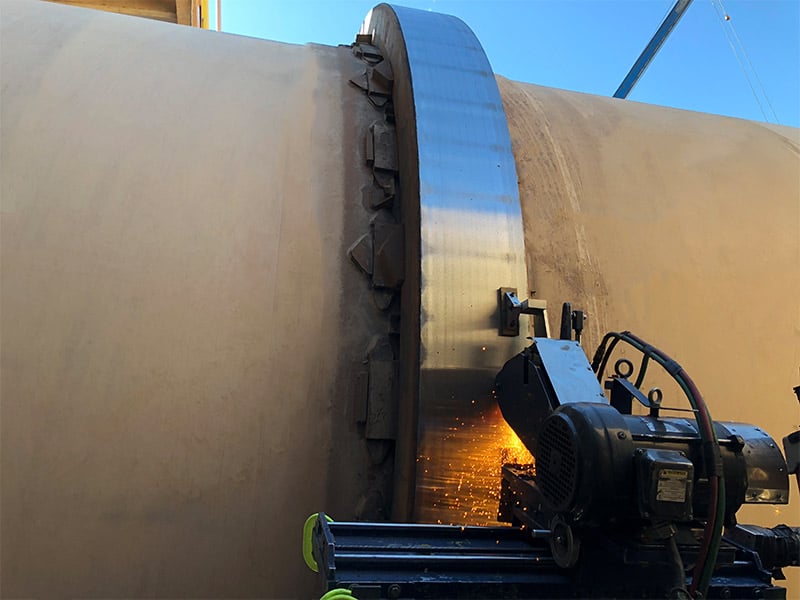
Tire grinding in progress
Recognizing Tire Mounting Assembly Maintenance Requirements
One often-overlooked aspect of maintenance is the tire mounting assembly. Maintenance procedures and frequency vary by type, with the floating tire offering the best compromise between longevity and maintenance requirements.
Sites with drums built decades ago can often reduce their maintenance requirements by having their drum retrofitted with the floating tire mounting style.
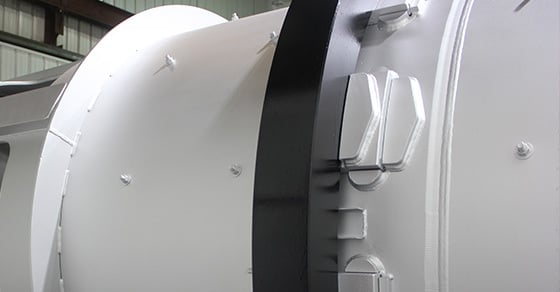
Floating tire mounting assembly
Checking Binder Delivery and Spray Systems
Agglomeration quality is only as good as the binder distribution. Spray nozzle inspection should be regularly conducted. Plugged or misdirected nozzles result in uneven binder coverage, which produces a mix of over-wet and under-wet agglomerates that will segregate, break down, or put recovery targets at risk.
For systems utilizing an acidic leachate, nozzle material selection matters. Standard stainless fittings will deteriorate in prolonged acid contact; high-alloy or HDPE components are required in contact zones. Keeping a flush kit on-hand and training operators to clear nozzles without full disassembly reduces downtime and injury risk.
Establishing a Strategic Parts Inventory
Having the right parts on hand can mean the difference between hours and weeks of downtime, underscoring the critical role of a well-planned spare parts inventory.
Operators should work with their OEM to develop an inventory of wear-critical parts to keep on hand, as well as components that tend to have higher lead times or are subject to market volatility.
Conclusion
While a quality agglomeration drum is built for reliability, the failure consequences associated with not keeping up on maintenance—lost throughput, degraded heap permeability, reduced recoveries—are disproportionate to the cost of preventing them. This is particularly true in remote settings where parts and service are not readily available.
In a market where heap leach operations are being asked to deliver more from the same infrastructure, maintaining agglomeration drum health is one of the highest-leverage investments an operations team can make.
FEECO International has been designing and servicing agglomeration drums for heap leaching operations since 1951. For technical support, replacement parts, or to discuss drum performance challenges specific to your operation, contact us today!

