
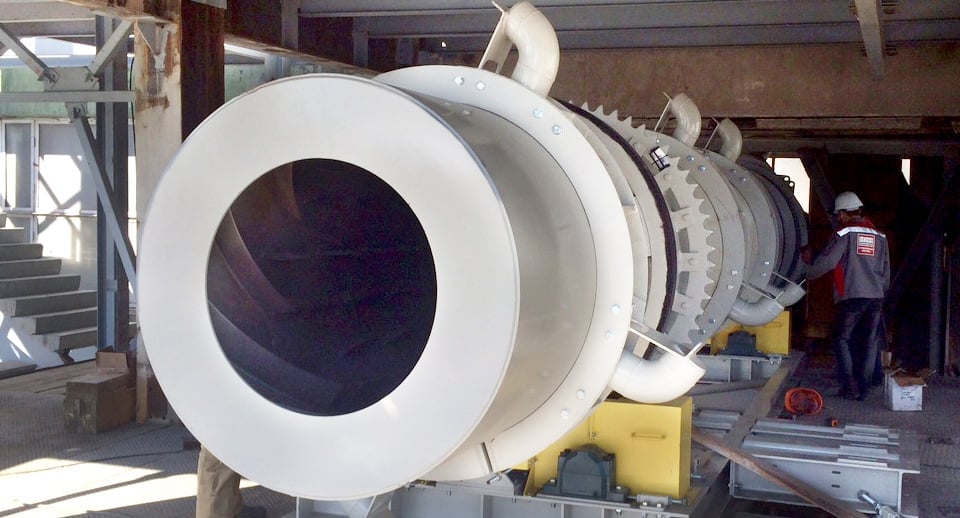
Knocking systems prevent buildup in rotary dryers, coolers, granulation/agglomeration, conditioning, and coating drums due to sticky or high-moisture materials. Controlling buildup is a critical aspect of maintaining product integrity and preventing damage to equipment.
FEECO can provide replacement components, complete knocking systems, or retrofit your existing drum with a knocking system to reduce buildup on the drum’s interior.
AVAILABLE KNOCKING SYSTEMS
FEECO offers two primary designs for knockers:
BALL AND TUBE
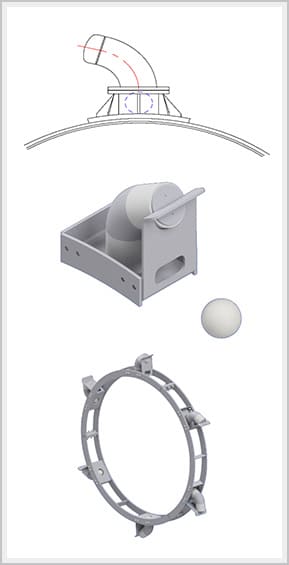
The ball-and-tube knocking system offers an effective, self-contained option at a low capital cost. A knocker band is welded to the shell, and balls fall against the drum via gravity as the drum rotates. Ball chambers are lined with reinforced bands to withstand ball movement in both directions.
Key Features:
- Heavy impact force for effective removal of material buildup.
- Bolt on design allows for easy installation to an existing drum.
- Modular design allows individual knocker assemblies to be removed without having to remove the entire band.
- Self-contained knocker assemblies require little to no maintenance.
- Impact plates are not fixed to drum shell, which prevents damage to drum shell.
- Bands can be added or removed as needed.
- Easy to index knocker bands to each other to achieve maximum buildup removal.
While this system is mechanically simple and cost-effective, ongoing replacement of components can make this design more costly on a long-term basis. It is also less favored because of the excessive noise and lack of operating controls.
PNEUMATIC HAMMER
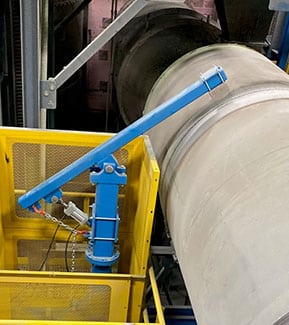
The pneumatic hammer is a solenoid activated hammer that offers extreme flexibility. Mounted above a strike plate on the drum, this hammer delivers an adjustable amount of force, as set by the operator. Force, frequency, and strike intervals can be easily adjusted to custom variables.
Key Features:
- Variable force allows you to customize the amount of force the drum receives for optimal buildup removal.
- Variable frequency enables the drum to be knocked in a different location with each strike as the drum rotates.
- Can be easily retrofitted onto any existing drum.
- Knockers can be turned off for noise reduction when not needed.
- Multiple knocking assemblies can be run off of a single control point.
COMMON FACTORS TO CONSIDER WHEN DECIDING ON A KNOCKING SYSTEM:
- Adjust Impact Force
- Adjust Impact Location
- Adjust Frequency of Impacts
- Ease of Inspection
- Space (Swing) Requirements
- Simplicity of Design
- Power/Control Requirements
- Ease of Retrofit to Existing Drum
- Rolling Wear
- Quantity of Wear Items
- Safety/External Parts
- Applicable to Dusty/Corrosive Environments
- Applicable to High Temps
- Ease of Temp Stopping Impact
- Integrity to Drum Shell
- Noise
INDICATIONS THAT A KNOCKING SYSTEM MAY REQUIRE REPLACEMENT
Existing knocking systems exhibiting visible or audible signs of wear should be replaced, not only to maintain efficiency and product quality, but also to ensure a safe working environment.
A drum may also be showing signs of buildup, such as inconsistent product, reduced flow rate, or chunks of material.
Drums without an existing knocking system can easily be retrofitted with a new system for immediate improvement in buildup control.
Frequently Asked Questions (FAQs)
How often knockers require replacement depends on the type in use. Pneumatic hammers have a longer service life, with only the occasional need to replace the head or wear ring.
Ball-and-tube knockers have a shorter service life, typically around 4-6 years, due to the consistent impact force they experience.
Knockers have a typical lead time between 6 to 8 weeks for replacements, or 12 weeks for new systems/retrofits.
Yes. If replacing an existing system, consider whether your existing design is effective, or if an upgrade could provide improved performance. Further, since the drum will need to be shut down during install, it is often beneficial to carry out other maintenance and repairs, or have the service provider conduct a full inspection.
Contact us, providing the following information:
- Shell material of construction
- Shell thickness
- Length of drum
- Photos
- Where in the unit sticking occurs