
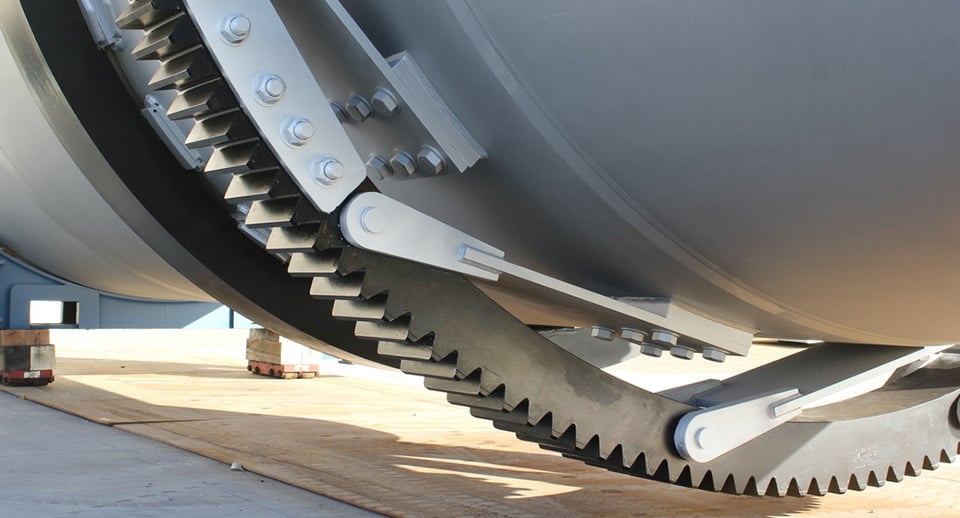
A girth gear, also known as a ring or bull gear, is a large-diameter gear fitted onto the circumference of a rotary drum to transmit rotational drive from the pinion gear, causing drum rotation.
When properly fabricated and maintained, a quality girth gear can last more than 25 years. However, if proper lubrication, maintenance, or inspections are overlooked, or the gear is exposed to tramp material, excess wear and damage may occur.
As a principle structural component, the girth gear has widespread effects when allowed to wear, risking potential damage and downtime in rotary dryers, kilns, and other rotary drum equipment. As a result, gear wear should be addressed immediately, typically through replacement, though in cases of onset wear, simple adjustments may prevent further damage.
Preventative replacement of a girth gear is significantly more cost-effective than addressing equipment failure later, particularly considering that girth gears can have a long lead time.
Available Gears
FEECO offers high-quality replacement girth gears in a variety of options:
| Available Sizes | Diameters ranging from 60” to 180” |
| Available Materials | 4340 carbon steel 4140 carbon steel |
| Face Width | In excess of 25″ |
As hardness of the girth and pinion gears plays an essential role in maximizing equipment life, gears are flame- or induction-hardened to achieve the required hardness.
FEECO follows American Gear Manufacturers Association (AGMA) guidelines to ensure gears meet the highest quality standards.
Indications That a Gear may Need Replacement
Wear and damage can be observed by examining the gear teeth and the way they mesh. Improper backlash (the clearance between meshing teeth) may lead to gear wear. Backlash is set at installation and should be regularly monitored as part of an inspection program, with excessive backlash causing impact loading and accelerated tooth-face damage. Less commonly, insufficient backlash can create heat buildup, and cause tooth interference and gear damage. Improperly set backlash at installation is one of the most common causes of premature gear wear.
Less obvious wear can be detected using a gear run-out. A gear run-out not only measures tooth height variation but can also reveal backlash inconsistencies around the drum’s circumference, indicating uneven wear or mounting issues.
A worn gear may also exhibit unusual vibrations in the drive area, growling noises, or even wear patterns on the tires and trunnions.
FEECO can perform an inspection to assess the mechanical condition of both girth and pinion gears as needed.
Girth Gear Installation & Replacement
Because improper installation could compromise the integrity of the girth gear and its service life, girth gears should be installed or replaced by a trained expert. FEECO can offer both installation/replacement and supervisory services, as well as full drive assembly replacement.
The length of time required for gear replacement can vary based on a number of factors. In general, the average gear replacement takes between three and six days, with gear size and mounting style influencing the length of time required. Access to the drum can also influence how long the process takes.
Pinion Gear Replacement
FEECO recommends replacing the pinion gear at the same time as the girth gear. Not only does this avoid an additional shutdown for replacing the pinion gear in the future, but it prevents damage to the new girth gear that could otherwise be caused by pairing it with a worn pinion.
Gear-Mounting Replacement
Depending on the level of duty required and whether or not the drum is heated (i.e., a dryer or kiln), FEECO offers two different gear-mounting styles: Flange- and Spring-Mounted.
We recommend replacing all mounting hardware as part of the gear replacement process, but in some cases can accommodate the reuse of some hardware as needed. Because we recommend replacing all hardware, the need for gear replacement is a good time to reassess the mounting style.
Rotary Drum Alignment
It’s important to note that a realignment of the trunnions should be performed after gear replacement.
Data Required
The following information will be required in ordering a replacement girth gear:
- Serial number and any changes in specification (if the drum was built by FEECO)
If the drum was not originally built by FEECO, the following information will be needed:
- Inside diameter of the rotary drum
- Pitch diameter
- Number of teeth
- Diametral pitch (size and spacing of teeth – can also be determined through pitch diameter and tooth count)
- Face width
- Rotation speed
- Material and hardness
- Mounting method
- Drive horsepower
This information can typically be found in original equipment manufacturer (OEM) drawings or by taking physical measurements. FEECO can also conduct an equipment audit to determine the most appropriate specifications and evaluate the drum’s overall mechanical condition.
Frequently Asked Questions (FAQs)
How often a girth gear requires replacement depends on its unique operating conditions and how well it is maintained, with properly maintained gears often having a service life of more than 25 years.
Lead time for a girth gear can vary depending on the size and circumstances, but can range from 8-24 weeks.
Yes. FEECO recommends replacing both the girth and pinion gears at the same time to avoid the risk of damaging a new gear by pairing it with an old, worn gear. As new mounting hardware is also recommended, the mounting style should also be re-evaluated.
Additionally, because the gear is part of the drum’s structure and contributes to mechanical stability, a full laser alignment should be performed after gear replacement.
Several signs may indicate that a gear requires replacement. This may include:
- Unusual vibrations in the drive area
- A growling noise in the drive area
- Wear on tires and/or trunnions
- Worn or missing teeth
If you are an existing FEECO customer, contact your dedicated parts person. Be sure to include the following information in your request:
- FEECO serial number
- Any changes in specs
If FEECO did not provide the original gear, fill out our contact form and include the following information:
- Inside diameter of the rotary drum
- Pitch diameter
- Number of teeth
- Diametral pitch
- Face width
- Rotation speed
- Material and hardness
- Mounting method
- Drive horsepower
Gear backlash is the intentional clearance between mating gear and pinion teeth that allows for thermal expansion, lubricant film, and manufacturing tolerances. Properly set backlash is critical to gear health; too much backlash can cause impact loading and accelerated wear, while backlash that is too tight can cause binding and overheating.
The size of girth gear you need depends on several specifications, with each gear engineered to its unique application. Girth gear size is determined through examining primary dimensions, gear geometry, and material and mounting style, gathering the following data points through physical measurements or OEM drawings:
- Drive horsepower
- Inside diameter of the rotary drum
- Pitch diameter
- Number of teeth
- Diametral pitch
- Face width
- Rotation speed
- Material and hardness
- Mounting method