
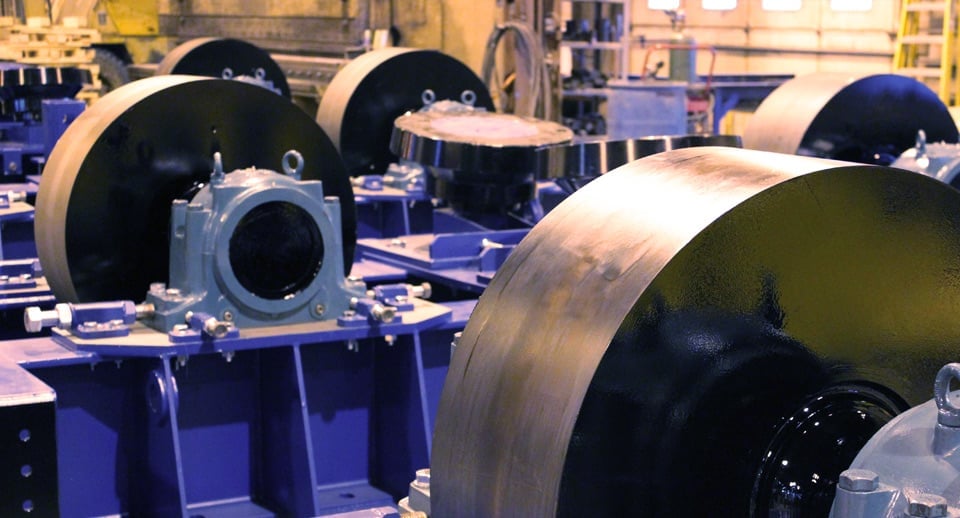
Trunnion wheels act as a cradle to support the weight of the rotating drum, while also providing a smooth service for the tire (riding ring) to ride against. As part of the drum’s support base, problems with the trunnion wheels should be addressed immediately to avoid escalating damage.
While trunnions can be resurfaced via tire grinding, severe wear or damage will necessitate replacement.
AVAILABLE TRUNNION WheelS
As trunnion wheels must exhibit greater hardness than the riding ring, FEECO offers replacement trunnions in 4140 or 4340 steel. Trunnions are available with a face width up to 36”.
INDICATIONS THAT A TRUNNION wheel MAY NEED REPLACEMENT
A trunnion wheel in need of replacement exhibits excessive wear, such as defects in the face, a broken shaft, or a diameter that is too small to provide adequate support.
It is important to match the tires to the trunnion wheels in both material composition and hardness. Failure to do so can result in premature wear and/or failure. FEECO has a team of field service engineers that can measure existing components in the field and recommend proper replacement specifications.
Frequently Asked Questions (FAQs)
Trunnion wheels require replacement when they become too worn or damaged to be repaired via resurfacing or grinding, or when the diameter is less than 90% of the original size.
The lifespan of this component is entirely dependent on its unique operating conditions and is therefore different for each and every installation. Because damaged trunnions affect the mechanical stability of the rest of the drum, damaged wheels should be replaced as soon as possible.
Trunnion wheel lead time ranges around 6-10 weeks, depending on size, though varying circumstances may influence lead time.
Yes. If one trunnion wheel is worn, others are likely wearing as well, making it common to replace trunnions in pairs to avoid unnecessary downtime. A full laser alignment should be performed with the installation of new wheels.
Yes. When trunnion wheels only exhibit superficial wear such as timing marks, they can be restored through grinding, a resurfacing process that grinds away wear to expose the like-new surface below. More significant wear, such as cracks, thin spots, or wear that exceeds more than 10% of the trunnion’s original diameter, will require replacement.
If your rotary drum was manufactured by FEECO, contact your dedicated parts person with the FEECO serial number and any changes in specification.
If FEECO did not manufacture the drum, contact us and provide the following information:
- Shaft length
- Inside diameter of the rotary drum
- Outside diameter of the rotary drum
- Face width
- Material of construction and hardness