



As demand for lithium continues to surge, the rising use of novel lithium sources, paired with the growing need to maximize process efficiency and the push for a circular economy, are all driving research and development work around extracting and recovering lithium.
Findings from Grand View Research anticipate the lithium market will see a compound annual growth rate (CAGR) of 14.5% from 2026-2033; what is today roughly a $33 billion market is expected to reach $96 billion by 2033.[1]
To meet these ever-changing demands, producers are finding they must leverage every opportunity to maximize recovery, making facilities such as the FEECO Innovation Center, which can test various aspects of lithium processing, vital to establishing effective, efficient commercial-scale processes.
Why is Lithium Process Development Testing Important?
While the advantages to testing are numerous, they can all be summarized under one key benefit: de-risking the scale-up process. Whether optimizing a standard lithium flow sheet or establishing an entirely new process, testing mitigates many of the risks associated with scale-up, while also ensuring the process performs as efficiently as possible, yielding maximum recovery.
Optimizing Standard Lithium Extraction Flowsheets
Lithium producers are under increasing pressure to maximize recovery as efficiently as possible. By optimizing the various process steps in the flow sheet, whether from brine or hard rock sources, producers must fine-tune their operations to minimize even the smallest of inefficiencies.
Establishing Process Criteria Around Novel Processes and Sources
Rising demand for lithium, along with the challenges associated with traditional processing routes (hard rock and brine extraction), has producers on the hunt for both new sources of lithium and improved ways of extracting it.
Producers are exploring every avenue, from recovering lithium from clay deposits to selectively extracting it from alternative brine sources (direct lithium extraction/DLE). These new avenues to market-ready lithium chemicals are largely in nascent stages, requiring significant development to reach commercial viability.
Through testing, lithium producers can establish feasibility/proof of concept, illustrate proof of process, and gather essential data for scale-up, all of which significantly de-risk the path to commercial-scale production in a constantly changing industry.
What Types of Testing are Available for Lithium?
The Innovation Center is unique in that it has the capability to test many of the different processes used in lithium production. This provides a major advantage to producers looking to test multiple process components and refine how they fit together.
Drying
Whether lithium is extracted from ore, brine, or even clay, drying is an essential finishing step to meet market expectations and downstream equipment requirements. Reaching the target moisture requires a careful balance of several factors, all of which can be tested in the FEECO Innovation Center, where both rotary and fluid bed dryers are available for testing:
- Air flow configuration (co-current or counter-current)
- Inlet and outlet temperatures
- Residence time
- Flight design and pattern (rotary)
- Fluidization regime (fluid bed)
- Gas sampling and analysis
- Feedstock characteristics (particle size distribution, bulk density, crush strength, moisture content, etc.)
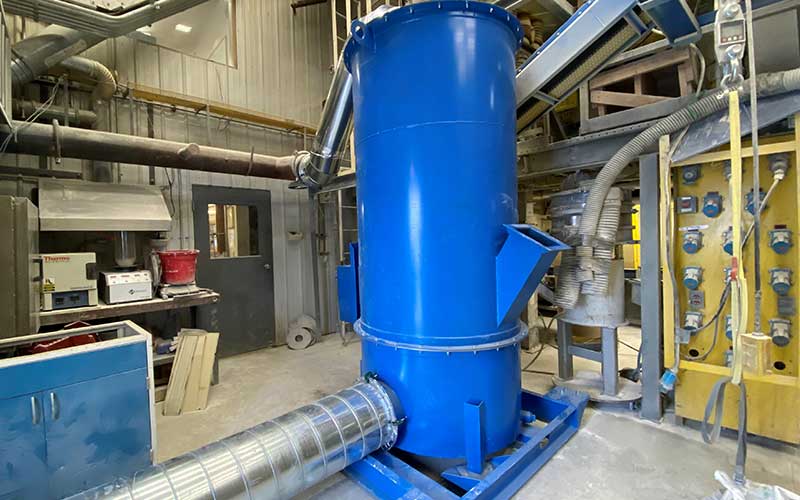
Pilot-scale fluid bed dryer used for testing
Mixing
Mixing is employed in the spodumene sulfation process to combine sulfuric acid with spodumene ore ahead of acid roasting. The effectiveness of lithium recovery from spodumene relies heavily on the ability to achieve a uniform mixture of the liquid acid and solid calcine during this step.
In the Innovation Center, a pilot-scale pugmill mixer can be used to test a variety of process variables for maximum homogeneity. This includes:
- Solid and liquid feed rates
- Acid-to-solid ratio
- Acid concentration
- Residence time
- Mixer shaft speed
- Spray positioning
- Paddle placement and direction
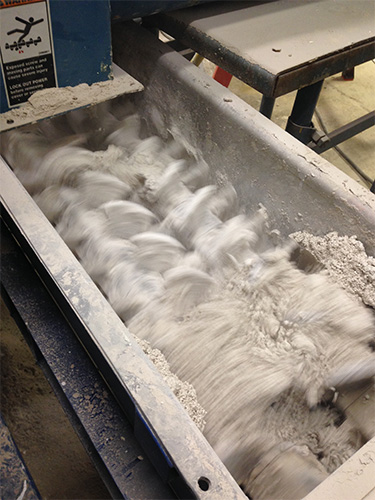
Pilot-scale pugmill mixer testing in progress
Agglomeration
The growing use of flotation to concentrate low-grade ores and complex deposits is increasing the need for an agglomeration step to upgrade fines prior to thermal treatment, particularly in the case of spodumene.
By agglomerating spodumene concentrate into uniform granules, producers can improve performance in the downstream kiln, eliminating dust and ensuring optimal bed permeability.
Through testing, producers can determine the process configuration needed to produce granules with the desired bulk density, particle size distribution (PSD), crush strength, and more.
Agglomeration can be carried out using a pin mixer, disc pelletizer, pugmill mixer, agglomeration drum, or combination thereof. Test work can identify the most effective approach based on a representative sample, as well as fine-tune variables around the selected approach. This often centers around establishing ideal:
- Rotational speed
- Solid and liquid feed rates
- Number and location of sprays
Agglomeration testing is also valuable to producers utilizing sorbents or catalysts in direct lithium extraction (DLE) processes, allowing them to fine-tune both the process and granule parameters.
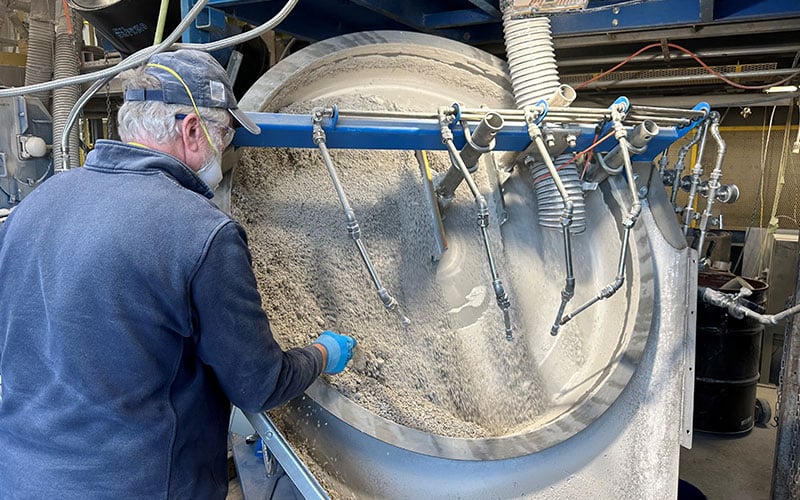
Disc pelletizer test in progress
High-Temperature Thermal Treatment
Thermal treatment underlies several steps in the lithium lifecycle. In extracting lithium from virgin resources, thermal treatment in a rotary kiln is the foundation of recovering lithium from its primary hard rock ore source, spodumene. Producers must first convert α-spodumene to β-spodumene (often referred to as decrepitation) via calcination in order for further treatment to be successful. Following this step, an acid bake kiln roasts spodumene ore combined with sulfuric acid to form lithium sulfate, which can be recovered through subsequent leaching.
In addition to bringing new lithium to market, thermal treatment is also often employed in the recovery of the metal from spent lithium-ion batteries (LIBs), an application gaining increasing traction as the United States, among other nations, looks to establish a circular economy around batteries and critical minerals.
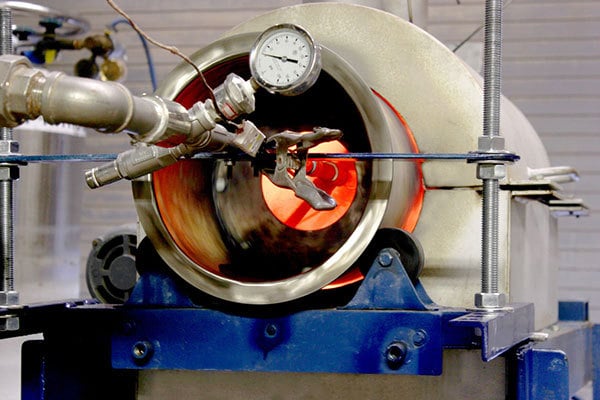
Batch indirect kiln test in progress
As the choice between direct or indirect kiln has typically already been made based on the intended process, thermal testing typically focuses on refining key process variables, including:
- Drum rotational speed
- Drum slope
- Temperature profiles
- Pretreatment requirements, if any
- Gas sampling and analysis
- Air flow configuration (direct only – co-current or counter-current)
- Feed rate
Conclusion
The ever-expanding demand for lithium is spurring an unprecedented need for process development facilities. Whether optimizing a standard approach, evaluating a non-traditional source, or developing a new flow sheet, thorough test work is pivotal to maximizing efficiency and de-risking the path to commercialization.
With capabilities in drying, mixing, agglomeration, and high-temperature treatment, the FEECO Innovation Center offers lithium producers and recyclers a unique opportunity to test nearly every aspect of their process under a range of conditions, all at the same location. To learn more about the Innovation Center’s testing capabilities, or to schedule a test, contact us today!
SOURCES:
Grand View Research. (n.d.). Lithium market size, share & growth: Industry report, 2033. Lithium Market Size, Share & Growth | Industry Report, 2033. https://www.grandviewresearch.com/industry-analysis/lithium-market

