


Agglomeration is emerging as a valuable complement to flotation in modern spodumene processing operations. As lithium demand drives the development of lower-grade and more complex deposits, the finer concentrate produced from flotation streams can challenge downstream calcination. The conversion of α-spodumene to β-spodumene requires consistent temperature exposure and controlled residence time, conditions that may be hindered by excessive fines.
In operations where excessive fines compromise kiln performance, agglomeration serves as a strategic step to improve material behavior during thermal treatment.
Agglomeration: Flotation’s Complement
Froth flotation is becoming increasingly important in concentrating spodumene ores amidst the rising exploitation of more complex ore bodies and declining ore grades.
While flotation is effective in producing an upgraded spodumene concentrate, the resulting material exhibits a finer particle size distribution (PSD) than other methods.[1]
Paired with the growing use of finer-grained ores, the presence of fines becomes a challenge in the subsequent calcination process required to convert α-spodumene to more reactive β-spodumene (decrepitation). To ensure calcination will be effective in carrying out this phase transition, producers employ agglomeration.
What is Agglomeration?
Agglomeration is the process of particle size enlargement, essentially converting powders, dust, and fines into larger, more cohesive particles in the form of granules, pellets, or briquettes.
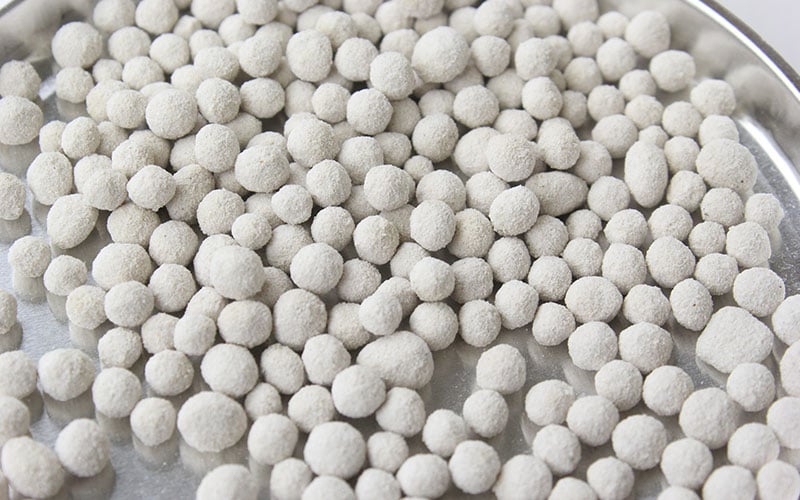
Pellets produced via agitation agglomeration
Agglomeration is widely used as a pretreatment step in preparation of thermal processing such as calcination and roasting. In these settings, the use of larger granules instead of fines can improve reactor performance, helping to ensure all material is thoroughly processed as efficiently as possible.
Agglomeration improves the subsequent calcination process in a few key ways:
Eliminating Dust
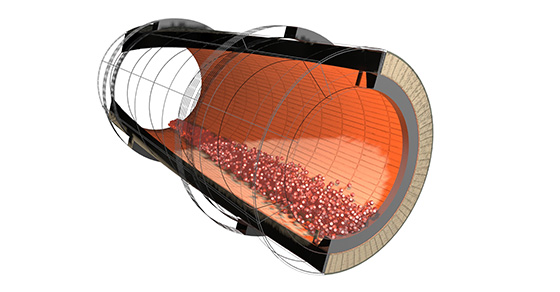
Spodumene ore calcination is frequently carried out in a direct-fired rotary kiln, which puts material in contact with combustion gases to elicit the chemical reaction.
Combustion gases are passed through the rotating kiln, directly over the material bed. Thus, the presence of dust or fines in such settings is highly problematic, causing material to become entrained in the gas flow and carried out through the exhaust gas system. This is often referred to as carryover and results in lost product and/or a high rate of reprocessing.
While dust collection systems are standard in spodumene calcination circuits, reducing fines in the kiln feed can lower entrainment losses and reduce reprocessing load.
Promoting Maximum Bed Permeability
Beyond the issues associated with dust in a kiln, fine particles are problematic from a heat transfer perspective as well.
Studies on solids transport within rotary kilns have shown that sized-based segregation of particles can occur, with the potential for fine particles to accumulate as a central “core” in the material bed. This prevents uniform heat distribution, resulting in the inner core of material not being exposed to the necessary reaction temperatures.[2]
Similarly, excess fines in the material bed can also inhibit bed permeability by clogging channels between larger particles, preventing heat from penetrating through the bed and creating “cold pockets” of material.
By agglomerating material prior to the rotary kiln, producers can improve gas–solid contact and promote more uniform heat penetration through the material bed.
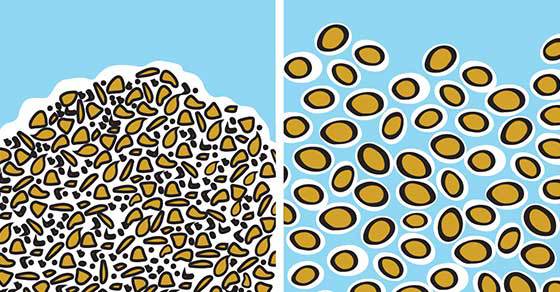
This illustration shows how uniform granules improve gas-solid contact
Why Agitation Agglomeration?
While other types of agglomeration are also utilized, agitation agglomeration, also known as tumble-growth agglomeration, pelletizing, or wet granulation, produces uniform, spherical granules. In a rotary kiln, this promotes enhanced heat transfer through:
Lower Attrition (Less Dust)
Other types of agglomerates (ex., briquettes) have sharp edges that can rub together and break away into fines (a phenomenon referred to as attrition). Because round granules do not have jagged edges, they generally experience minimal attrition and dust generation.
Maximum Gas-to-Solid Exposure
While jagged granules may interlock, causing blockages in a material bed, round granules encourage maximum exposure between the gas and solids due to the spaces created between round granules.
Greater Surface Area
Pellets produced via agitation agglomeration are formed through layering, which promotes a more porous granular product compared to those produced using extreme pressure. When properly formulated, pellets produced via agitation agglomeration can exhibit controlled porosity, supporting improved heat transfer and internal diffusion during calcination.
Improved Heat Transfer and Diffusion
The more dense granules produced via pressure agglomeration techniques can slow heat transfer and diffusion, making the process inherently less efficient. In contrast, the porous granules created through agitation agglomeration are more efficient at transferring heat.
These attributes make agitation agglomeration techniques ideal for preparing spodumene concentrates for subsequent thermal treatment.
The Agitation Agglomeration Process
Several options are available for carrying out agitation agglomeration. The most common approaches are outlined here, the choice between which is based on product goals and user preference.
Pin Mixer + Disc Pelletizer Combination
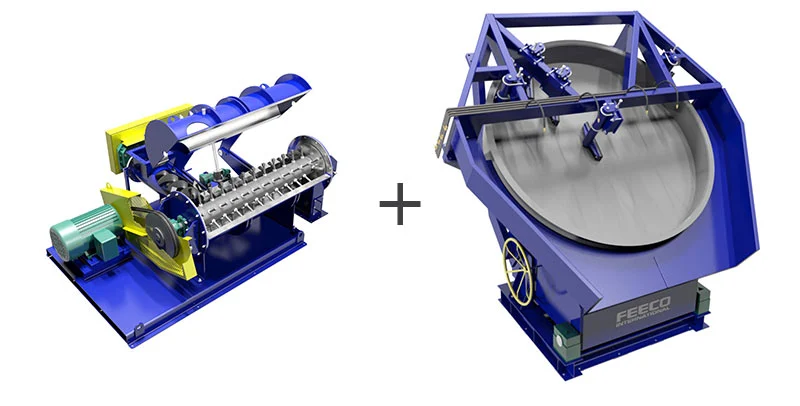
3D Rendering showing a pin mixer (left) and disc pelletizer (right)
The most common approach to agglomerating spodumene concentrates is the pin mixer + disc pelletizer combination.
The highly refined round pellets within a narrow particle size distribution (PSD) that this process configuration yields promotes optimal heat transfer within the kiln.
How it Works:
Material fines, along with water or other liquid binder, are fed into the pin mixer. The solid and liquid feed components are intimately combined to produce a homogeneous mixture. As the mixture continues to move toward discharge, the high-speed centrifugal force causes small “seed pellets” to form.
Seed pellets are discharged from the pin mixer and fed onto the rotating pan of the disc pelletizer, along with additional binder and solid fines. As the seed pellets travel on the disc, they move through the binder and fines feed, causing the growth layering effect that is the hallmark of this type of agglomeration.
Once pellets reach the desired size, they are discharged from the disc via centrifugal force. These “green” (wet) pellets may or may not undergo subsequent drying prior to decrepitation. In many operations, a controlled drying step is employed to reduce moisture prior to kiln feed in order to improve pellet durability and minimize energy loss to water evaporation during calcination.
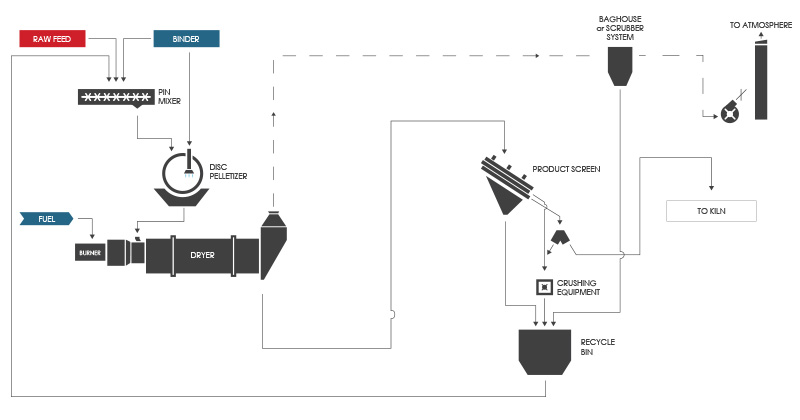
Simplified process flow diagram (PFD) of a spodumene concentrate pelletizing line utilizing a pin mixer and disc pelletizer with drying step
Note: Both the pin mixer and disc pelletizer can be used as standalone agglomeration devices. However, the highly refined spherical granules produced from their combination are ideal for optimizing thermal treatment.
Granulation Drum (Agglomerator)
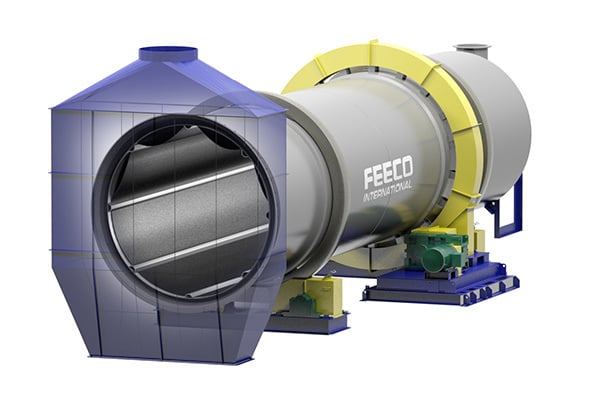
Though used less commonly, the granulation drum or agglomerator can also be used to pelletize spodumene concentrate in preparation for thermal treatment.
How it Works:
In this configuration, solid material is fed into the rotating drum. As the drum rotates, the liquid binder component is sprayed over the tumbling bed of material. Fines become tacky, causing them to pick up additional fines and accumulate growth layers as they tumble in the bed.
This approach yields a less refined product than the pin mixer + disc pelletizer configuration, but can be an effective solution in higher-capacity settings.
Here again, material may or may not undergo drying prior to calcination.
Essential Considerations in Agglomerating Spodumene Concentrate
Green Strength & Dry Strength
Green strength refers to the crush strength of pellets that have not gone through moisture reduction, while dry strength refers to the crush strength of those that have.
Whether or not the granules will go through a moisture reduction step prior to calcination, their crush strength is a critical factor in preventing product degradation in the kiln.
Pellets must be capable of moving through transfer points and kiln feeding without degradation, which would result in fines generation.
Both green and dry strength are dependent on several factors. And while the target strength may be a known variable, the process required to reach the target often relies on testing.
Binder selection and quantity, equipment rotational speed, drying parameters (in the case of dry strength), and other variables can all be modified to reach the target strength. These variables are best established as part of a thorough process development program.
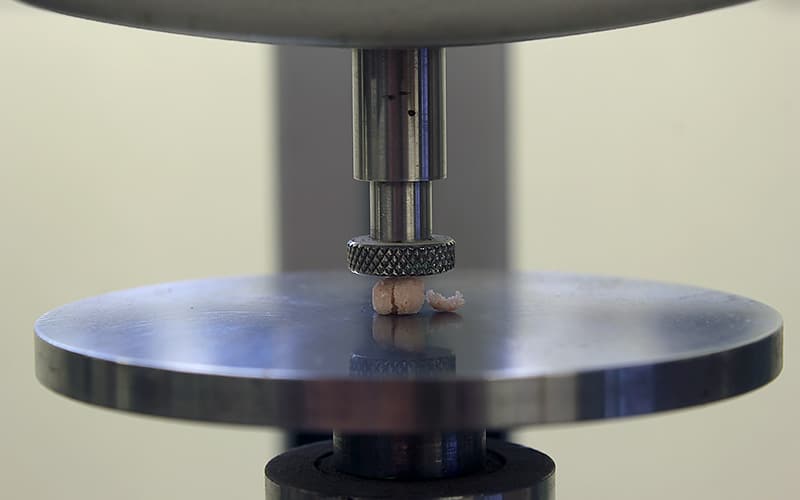
Crush strength test in progress in the FEECO Innovation Center
Variation in Ore Source
In addition to establishing and reaching the target crush strength, spodumene ore sources vary in both chemical and physical characteristics, affecting their ability to agglomerate (as well as their behavior in the kiln).
Because spodumene sources vary widely, laboratory and pilot-scale testing are often critical to establishing binder requirements, pellet strength targets, and optimal equipment configuration. Facilities such as the FEECO Innovation Center offer integrated testing across mixing, drying, and rotary kiln operations to support scale-up.
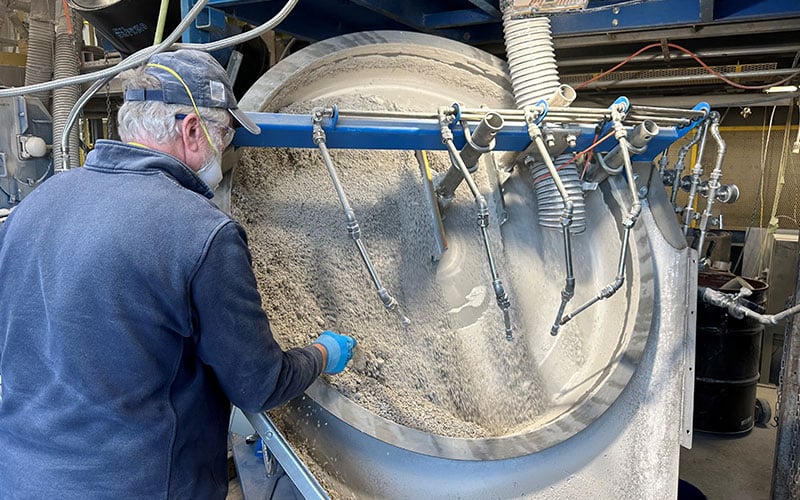
Disc pelletizer testing in progress in the FEECO Innovation Center
Conclusion
As lithium producers continue to exploit lower-grade and more complex spodumene deposits, agglomeration serves as a strategic link between concentration and calcination, transforming fines into engineered granules designed for optimal kiln performance.
By improving bed permeability, minimizing dust carryover, enhancing gas–solid contact, and promoting more uniform heat transfer, agitation agglomeration can significantly improve the efficiency and reliability of α- to β-spodumene conversion. When properly designed around the specific mineralogy and particle characteristics of a given ore body, agglomeration supports more consistent kiln operation, reduced material loss, and improved downstream conversion performance.
Backed by more than 75 years of experience and a dedicated process development facility, FEECO supports the design and optimization of agglomeration systems for spodumene concentrate conditioning prior to calcination. For more information on our custom equipment or testing, contact us today!
SOURCES
- Harman, Grant. 2019. “The Nature of Lithium Mineral Physical Properties in Selecting Calcination and Roasting Equipment.” ALTA 2019 Lithium Processing Proceedings, 24 May 2019, Perth, Australia; ALTA Metallurgical Services.
- Baby-Jean Robert Mungyeko Bisulandu, Florian Huchet. Rotary kiln process: An overview of physical mechanisms, models and applications. Applied Thermal Engineering, 2023, 221, pp.119637.10.1016/j.applthermaleng.2022.119637. hal-04102335

