


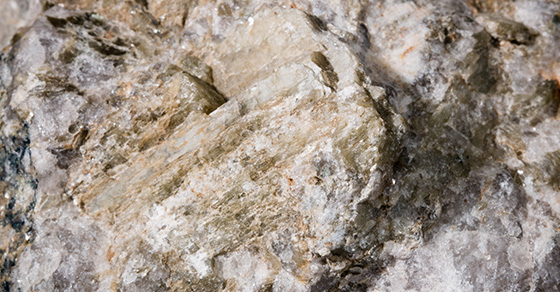
Pugmill mixers are widely used in the sulfuric acid (sulfation) process that extracts lithium from spodumene ore. As demand for lithium continues to mount, pugmill mixers are a pivotal tool in bringing lithium from spodumene sources to market, making a measurable difference in consistency, safety, and downstream recovery.
This article focuses on where pugmill mixers fit into the spodumene – lithium sulfate flowsheet, how this mixer works, and why testwork matters when you’re handling concentrated sulfuric acid in a paste-like, high-solids system.
How Does the Spodumene Sulfation Process Work?
The sulfuric acid process remains the primary route by which producers extract lithium from spodumene ore. A high-level overview of this process can be described as:
- Calcination/Roasting
- Mixing with sulfuric acid
- Acid roasting
- Water leaching
The initial calcination step, typically carried out in a rotary kiln, converts naturally occurring α-spodumene to more reactive β-spodumene (decrepitation), making it more amenable to lithium extraction. The ore is then ground to increase its surface area.[1]

Following conversion, ground β-spodumene is intensively mixed with concentrated sulfuric acid to produce a paste-like mixture in which the ore has absorbed the acid. This mixture will then be roasted again to produce water-soluble lithium sulfate (Li2SO4). [1]
Most modern spodumene conversion plants utilize a pugmill as a conditioning mixer ahead of a dedicated acid bake furnace. In some configurations, however, digestion may occur partially or entirely within a combined mixer-reactor.
Why Mixing Before Acid Digestion Matters
While achieving maximum lithium extraction hinges on every step of this sequence, the pugmill mixer plays an especially critical role. Achieving high lithium recovery depends on uniform contact between concentrated sulfuric acid and β-spodumene particles prior to roasting.
During the acid roasting process, hydrogen ions in the sulfuric acid replace the lithium ions in the spodumene. The lithium ions in turn combine with the sulfate ions to form lithium sulfate. Thorough mixing facilitates this exchange by maximizing the acid-to-spodumene contact.[2]
Why the Pugmill Mixer?
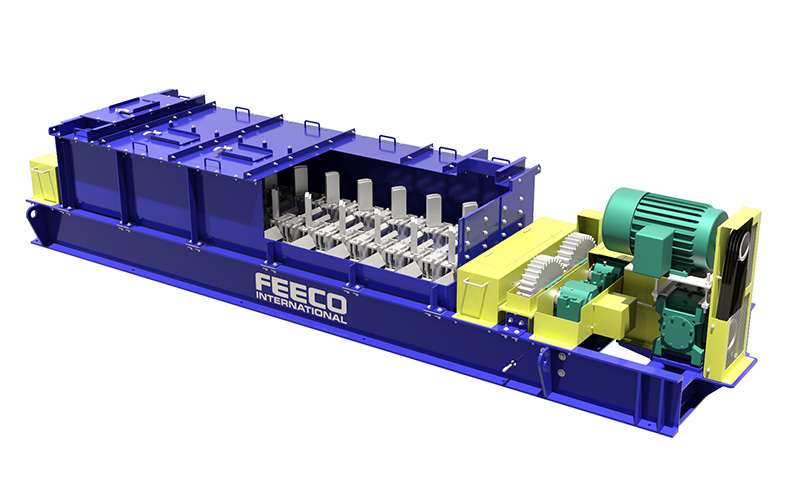
The pugmill mixer exhibits several features that have made it the preferred equipment choice in applications requiring intensive, caustic mixing:
Intimate Mixing of Solids & Liquids
The pugmill mixer consists of dual counter-rotating shafts that impart a kneading and folding motion on material that uniformly distributes the liquid component throughout the solids.
Heavy-Duty Construction
Spodumene is an abrasive mineral that could easily wear down ill-prepared equipment. Combined with the corrosive nature of concentrated sulfuric acid, the mixing process creates caustic processing conditions.
Pugmill mixers are engineered and fabricated for these types of settings, and the low-speed, high-torque mixing and folding reduces particle acceleration and impact compared to high-speed mixing, which can help manage wear in abrasive applications. Paddles can also be lined for added protection and are easily changed out when worn.
Pugmill mixers are especially preferred in settings utilizing a highly concentrated acid. While pugmill mixers are already robustly built, special materials of construction may be merited in such cases for added protection against corrosion. This might include the incorporation of replaceable liners, acid-resistant alloys, sealed shaft arrangements, and acid-compatible seals and bearings.
High Torque
The high solids content of the sulfuric acid and spodumene, a dry paste, requires a high level of torque, capable of powering through tough, high-solids mixtures.
These qualities make the pugmill mixer uniquely suited to combining concentrated sulfuric acid with spodumene to achieve a homogeneous blend.
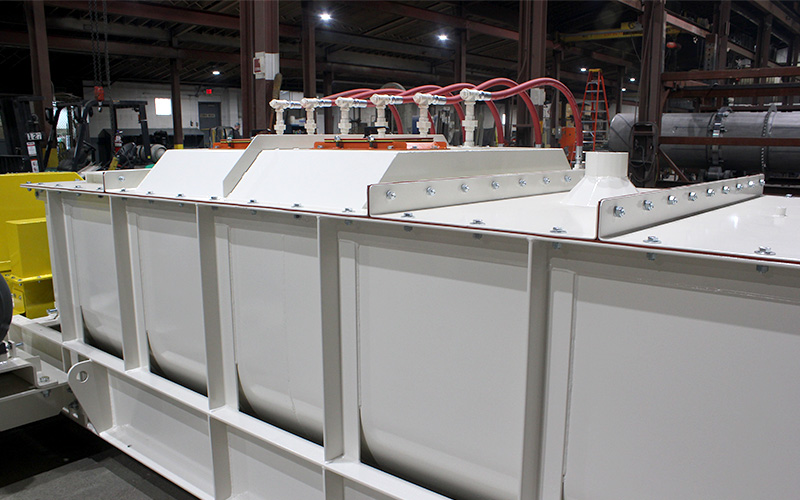
Pugmill mixer with raised cover and spray system
Acid Mixing Process Development
The critical nature of the acid mixing process requires process validation based on real-world data. Process development testing such as that carried out in the FEECO Innovation Center is essential to establishing process and equipment criteria. This is especially true given the variation that occurs across spodumene ore deposits, which can exhibit a wide range of physical and chemical diversity.
Through testing, lithium miners can test and confirm a number of key process and equipment variables, including:
- Acid concentration
- Acid-to-solid ratio
- Residence time
- Mixer speed
- Solid and liquid feed rates
- Spray positioning
- Paddle placement and direction
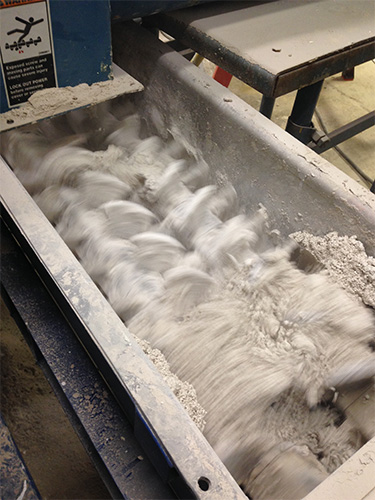
Pugmill mixer testing in progress in the FEECO Innovation Center
An added advantage to testing in the Innovation Center is the thermal testing equipment available; producers can utilize batch- and pilot-scale rotary kilns for testing the pre-mixing calcination (conversion of α-spodumene to β-spodumene), as well as post-mixing roasting.
At all stages, small samples can be produced for field trials. Rental units are also available for off-site testing.
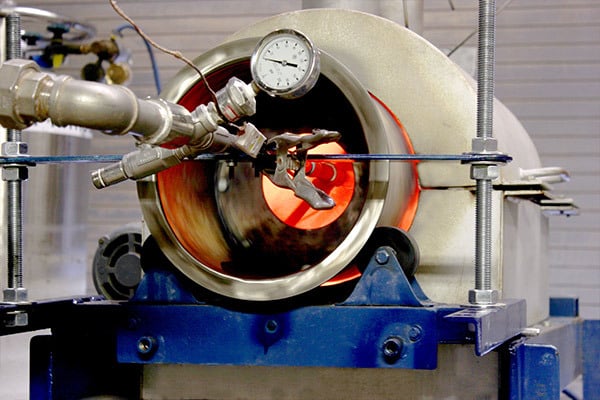
Batch-scale indirect kiln testing in the FEECO Innovation Center
Conclusion
Pugmill mixers remain an essential tool in extracting lithium from spodumene ore. The caustic conditions associated with mixing abrasive spodumene with corrosive sulfuric acid, paired with the need for thorough mixing, are well served through the mixer’s high-torque folding action and robust build.
Because spodumene concentrates can vary widely in both physical and chemical properties, pilot-scale testing is critical to successful process development, helping producers to establish essential process data.
With over 75 years of experience engineering, building, and servicing our custom pugmill mixers, plus a comprehensive on-site testing facility, FEECO serves as a critical partner in advancing lithium projects to meet ever-expanding demand. For more information on our equipment or testing services, contact us today!
SOURCES:
- Brady, George S., Henry R. Clauser, and John A. Vaccari. Materials Handbook. 15th ed. New York: McGraw-Hill Education, 2002.
- Ellestad, Reuben B., and Karl Milne Leute. Method of Extracting Lithium Values from Spodumene Ores. U.S. Patent 2,516,109, issued July 25, 1950.
Image Credit: Scott Horvath, USGS. Public domain

