


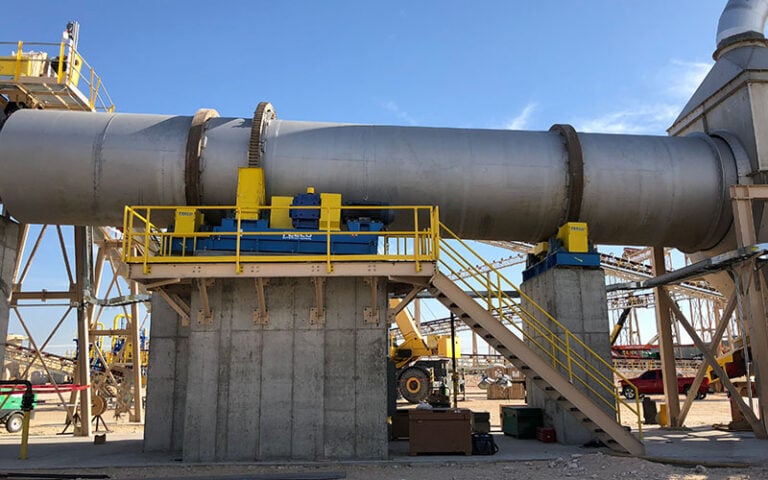
Rotary dryers play an increasingly important role as lithium producers work to meet rising demand for electric vehicles, energy storage, and electronics, pushing operations beyond simple extraction into the production of tightly specified, battery-grade chemicals. Across brine, hard-rock, and emerging clay projects, drying remains a key unit operation that converts lithium-bearing solutions into stable, market-ready products.
While a range of industrial drying technologies is available, rotary dryers continue to offer a reliable and versatile solution in many settings. The following explores the essential role of drying in the lithium space and where rotary dryers provide the best fit.
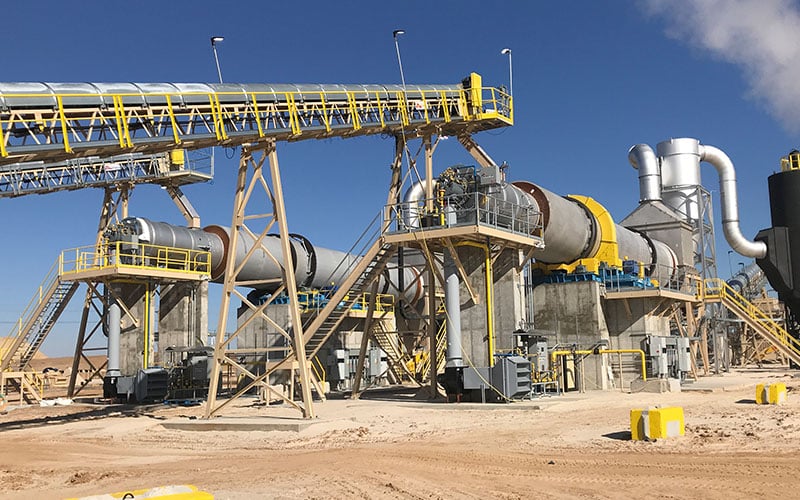
Rotary dryers at a mine site
Why is Drying Important in Lithium Refining?
Currently, commercial lithium supply comes primarily from brines and hard-rock ores, with clay-based projects moving toward commercialization and DLE emerging as an alternative approach to brine extraction.[1]
Drying Lithium from Brines
In traditional brine operations, lithium-rich brine is pumped from underground into a series of evaporation ponds where it is allowed to evaporate to the desired lithium chloride (LiCl) concentration, roughly 6%. At this stage, the material goes through processing to remove undesirable components such as magnesium, calcium, and boron, prior to refinement into lithium carbonate (Li2CO3) or lithium hydroxide (LiOH).[2]
In contrast, direct lithium extraction selectively removes lithium from brines, leaving behind the majority of undesirable salts that would otherwise require removal.[2]
While brine operations may vary, whether extracted from surface ponds or in-situ, they typically all employ a precipitation step to yield battery-grade lithium carbonate. Precipitation is followed by drying as a finishing step, often in a rotary dryer, to produce the final, market-ready lithium carbonate.[3]
Drying Hard-Rock Lithium Ores
In extracting lithium from hard-rock ore sources such as spodumene and other pegmatites, beneficiation follows a more conventional approach. Ore is mined, crushed, ground, and processed via froth flotation or other beneficiation technique(s) to yield a lithium-rich concentrate that can be further refined into battery-grade chemicals.[4]
This concentrate is then often dewatered and dried in a rotary dryer prior to further refining or shipment. In this setting, rotary dryers offer a heavy-duty, high-throughput option for moisture reduction.
Drying from Lithium Clays
Lithium-bearing clays and sedimentary deposits are moving from concept to demonstration, with Thacker Pass in Nevada serving as a prominent example. Proposed flow sheets for extracting lithium from clay are limited and varied in their approach. A recent life cycle assessment for three prominent clay projects, including Thacker Pass, found a drying step to be consistent in producing a commercial product.[5]
Whatever the source of lithium – brine, ore, or clay – it’s clear that drying is an essential step in producing a storable, stable product that can be sold for use or further refined to meet the exacting specifications required by the battery market. Drying lithium compounds, however, is not always a simple task.
Why is Drying Lithium Challenging?
In the scope of industrial minerals, drying lithium chemicals can be especially challenging for several reasons.
Tight Specifications
Moisture management is an essential aspect in the production of battery chemicals at every step, requiring industrial drying systems that can consistently and reliably meet target moisture content.
Hygroscopic and Reactive Products
Meeting precise moisture content specifications can be difficult given that some lithium compounds are hygroscopic and will not only absorb water from the atmosphere, but will also chemically react with it.
Moreover, lithium salts such as lithium hydroxide will also absorb CO2 from the ambient environment, resulting in carbonation (studies have actually shown lithium hydroxide to be an effective adsorbent for CO2). Research has found that by keeping ambient humidity low, carbonation is largely prevented, keeping chemical composition intact.[6]
As a result, depending on the specific lithium chemistry being processed, drying is often carried out in an indirect dryer, where the products of combustion are kept separate from the material, avoiding the risk of carbonation.
Harsh Processing Conditions
Another common challenge lithium producers face in the drying process is the harsh nature of lithium compounds. These compounds are often highly corrosive and reactive, requiring special materials of construction and careful attention to dryer design to avoid premature wear or failure.
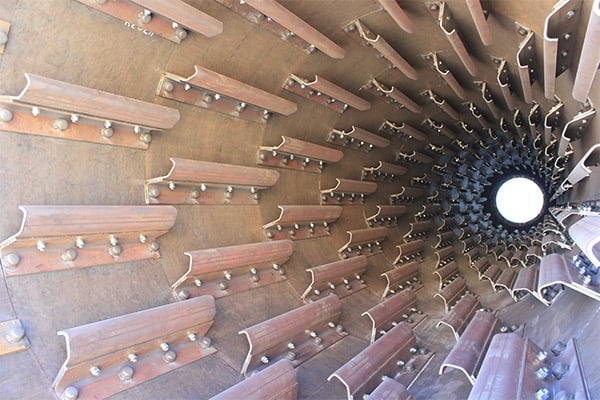
Interior view of rotary dryer with flights
Where Do Rotary Dryers Provide the Best Option for Drying Lithium Compounds?
Several dryer types are employed in the production of lithium chemicals, including vacuum, flash, fluid bed, and rotary dryers. Dryer selection is highly project specific, with several factors such as crystal morphology, purity requirements, and process integration guiding the most suitable choice.
Rotary dryers are preferred when the following conditions take priority:
Retention Time Control
Consistent, uniform drying relies on a stable retention (residence) time. Rotary dryers offer a flexible option in this setting, with several variables allowing control over retention time, including:
- Drum rotational speed (RPMs)
- Internal flight (material lifter) design and pattern
- Percent fill
- Buildup prevention
Continuous Operation
Lithium refineries tend to operate on a continuous basis, requiring a drying system that can handle continuous operation. Rotary dryers are ideal in this setting, with the capability to run continuously almost indefinitely.
Continuous operation can also be considered in terms of the rotary dryer’s tolerance to slight variations in feedstock. While feedstock uniformity should always be a top priority, small changes in moisture content or particle size will not lead to process upsets, like they will with some other dryer types.
Heavy-Duty Build
Lithium compounds can be extremely corrosive, exceeding even the already-robust build standards required by other mineral processing applications. The heavy-duty materials of construction and build quality typical of custom rotary dryers makes them especially well suited to processing lithium chemicals.
Dryer Reliability
Thanks to their robust construction, rotary dryers have a well-earned reputation for reliability in the mining industry.
High Throughput
Rotary dryers are also recognized for their high throughput – up to 300 TPH. Smaller dryers are also available, making rotary dryers applicable to everything from high-capacity refining applications, to specialized chemical production.
How Do You Determine if a Rotary Dryer is the Best Fit?
Rotary dryers are ideal in many settings, but are not always the most appropriate choice. When temperatures must be kept low for heat-sensitive materials, or where material consists of a fine, low-density powder, alternative drying technologies may offer better results.
Facilities such as the FEECO Innovation Center, which provides testing for both rotary and fluid bed dryer types, are crucial in establishing the most suitable drying technology, particularly when it comes to more novel lithium sources and flowsheets.
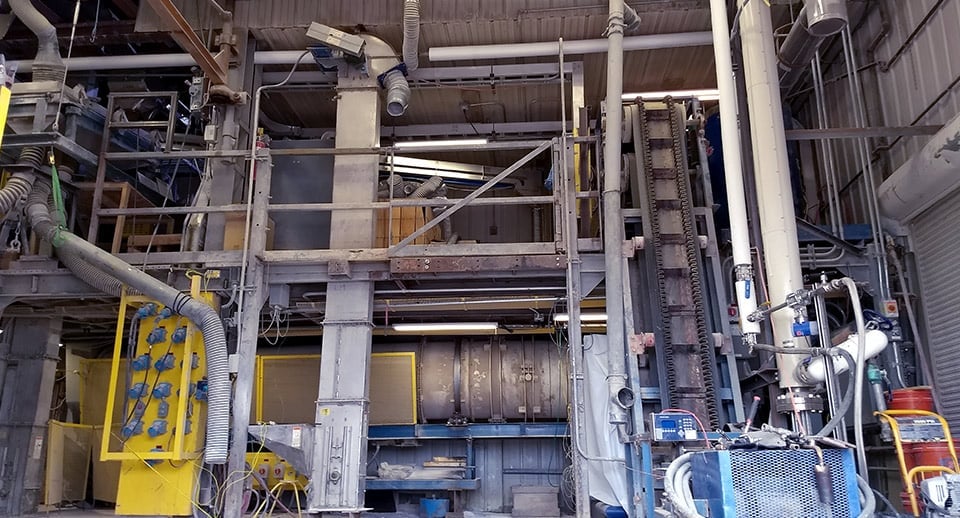
View of FEECO Innovation Center (rotary dryer can be seen in the background)
In addition to testing both dryer types, the Innovation Center can help lithium producers to establish the specific process and dryer configuration required to meet their precise moisture requirements. This includes establishing data such as:
- Inlet and outlet temperatures
- Feed and product flow rates
- Temperature profiles
- System pressure
- Direct or indirect configuration
- Air flow (co-current or counter-current – direct-fired only)
- Exhaust gas treatment
- Drum slope, speed, and percent fill (rotary only)
- Fluidization regime (fluid bed only)
Conclusion
Drying plays an indispensable role in transforming lithium-bearing materials into market-ready chemicals, whether the feed originates from brine, pegmatite, or emerging clay sources. While the specific drying approach varies widely with material characteristics, process chemistry, and product specifications, rotary dryers remain a key option in many lithium operations—particularly where high throughput, mechanical robustness, and flexible residence-time control are priorities.
Indirect rotary dryers, in particular, offer advantages in applications where atmosphere control and contamination prevention are critical, while direct-fired units continue to serve reliably in upstream concentrate drying.
As lithium production technologies continue to evolve, dryer selection will remain a process-specific decision. FEECO’s role lies in supporting producers with process development options and proven, heavy-duty rotary drying solutions. For more information on our custom rotary dryers, contact us today!
SOURCES:
- Marcinov, V., Klimko, J., Takáčová, Z., Pirošková, J., Miškufová, A., Sommerfeld, M., Dertmann, C., Friedrich, B., & Oráč, D. (2023). Lithium Production and Recovery Methods: Overview of Lithium Losses. Metals, 13(7), 1213. https://doi.org/10.3390/met13071213
- International Lithium Association Ltd. Direct Lithium Extraction (DLE): An Introduction. Version 1.0.1, June 2024. International Lithium Association, https://lithium.org/wp-content/uploads/2024/06/Direct-Lithium-Extraction-DLE-An-introduction-ILiA-June-2024-v.1-English-web.pdf.
- Schenker, Vanessa & Oberschelp, Christopher & Pfister, Stephan. (2022). Regionalized life cycle assessment of present and future lithium production for Li-ion batteries. 10.31223/X5TS7F.
- Krishnan, Renjith, and Gokul Gopan. A Comprehensive Review of Lithium Extraction: From Historical Perspectives to Emerging Technologies, Storage, and Environmental Considerations. Cleaner Engineering and Technology, vol. 20, 2024, art. no. 100749, https://www.sciencedirect.com/science/article/pii/S2666790824000296.
- Zhang, Xiang, Agostinho G. da Silva, Jheison A. O. Luna, and Joao F. D. Rodrigues. Comparative Life Cycle Assessment of Lithium Carbonate and Lithium Hydroxide Monohydrate Production from Lithium Minerogenic Resources. Journal of Cleaner Production, vol. 460, 2024, art. no. 141968, https://www.sciencedirect.com/science/article/pii/S0959652624024041.
- Jun Li, Tao Zeng, Noriyuki Kobayashi, Rongjun Wu, Haotai Xu, Lisheng Deng, Zhaohong He, Hongyu Huang, Carbonation Reaction of Lithium Hydroxide during Low Temperature Thermal Energy Storage Process, Journal of Renewable Materials, vol. 9, no. 9, 2021, Pages 1621-2630, ISSN 2164-6325, https://doi.org/10.32604/jrm.2021.015231.

