

Graphite has rapidly emerged as one of the most essential materials in modern industry, largely due to its role in lithium-ion batteries, advanced materials, and high-performance industrial applications. However, producing graphite products that meet increasingly stringent specifications, whether for purity, particle size, or morphology, requires precise control over each processing step.
From purification to particle engineering, graphite processing is highly sensitive to feedstock variability and process conditions, making process development testing a critical step in establishing a reliable and efficient flowsheet.
Why Testing is Essential in Graphite Processing
Graphite ores and synthetic precursors often vary widely in both physical and chemical properties; crystallinity, flake size, purity, surface chemistry, and more influence downstream processing behavior and final product performance.
These sensitivities make relying on generalized design assumptions ineffective, requiring process development to be grounded in real-world material behavior. Through process development testing, producers can:
- Evaluate how a specific graphite source behaves under real process conditions
- Optimize operating parameters prior to investing in commercial-scale equipment
- Reduce technical risk and avoid costly redesigns or underperforming systems
- Generate data for equipment sizing and scale-up
In short, testing takes a process from theory to practice, establishing critical process data and allowing for early identification and resolution of production challenges. This represents an increasingly critical step as graphite producers target higher-value, specification-driven markets.
The FEECO Innovation Center brings together several production methods in one facility to streamline various aspects of graphite processing and purification:
Graphite Agglomeration Testing: Engineering Particle Size and Shape
Agglomeration is critical in many graphite settings to avoid the many issues associated with powders and fines: poor handling, lack of flowability, and inconsistent downstream performance. Through agglomeration, producers can control particle characteristics such as particle size distribution (PSD), crush strength, and more to alleviate these challenges, instead improving handling, thermal efficiency, and product uniformity, all of which are essential for high-value graphite products.
This is especially relevant in applications such as:
- Spherical graphite production for battery anodes
- Dust mitigation for fine graphite powders
- Preparing feedstock for downstream thermal processing
Producers can trial the following objectives through testing in the FEECO Innovation Center:
- Pelletizing and granulation behavior
- Use of mixing to precondition material for agglomeration
- Binder selection and optimization
- Green and dry pellet strength
- PSD control and uniformity
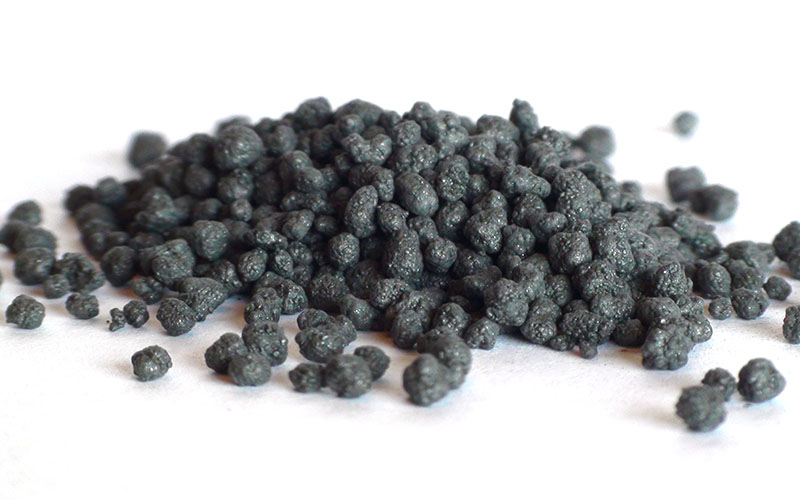
De-dusted graphite pellets
Equipment available for testing agglomeration-related processes in the Innovation Center includes:
Drying Testing: Managing Moisture for Process Efficiency
Precise moisture control also plays an essential role in graphite processing, where moisture content specifications are key to market acceptance. Following flotation and dewatering, graphite concentrates typically require drying prior to shipping or further processing.
Producers must be able to consistently meet moisture specifications, which requires a careful balance of several variables, both material and process, during moisture reduction.
Testing the drying process enables producers to determine:
- Temperature and residence time requirements
- Feed and product rates
- Airflow and energy requirements
- Risk of product degradation or dust generation
This is especially important because improper drying can lead to a host of issues, ranging from poor downstream processing to product quality inconsistency.
Producers can take advantage of a pilot-scale rotary dryer or fluid bed dryer in the Innovation Center. By simulating drying conditions at pilot scale, producers can establish reliable design parameters and avoid over- or under-sizing equipment.
Thermal Testing: Understanding Graphite Behavior at Elevated Temperatures
High-temperature treatment is the underlying foundation of many graphite processing operations, particularly in purification (thermal upgrading), calcination, and graphitization.
Research shows that thermal treatment can significantly alter a host of graphite parameters, directly influencing performance in end-use applications and thus requiring careful control over processing conditions.
Because graphite responds differently depending on its origin and prior processing history, thermal testing is essential to:
- Determine reaction temperatures and kinetics
- Evaluate structural changes during heating
- Optimize residence time and heating profiles
- Assess off-gassing and emissions
In the FEECO Innovation Center, testing in batch- and pilot-scale rotary kilns helps producers understand how their material will behave during processing, ensuring that thermal treatment achieves the desired product characteristics without compromising quality.
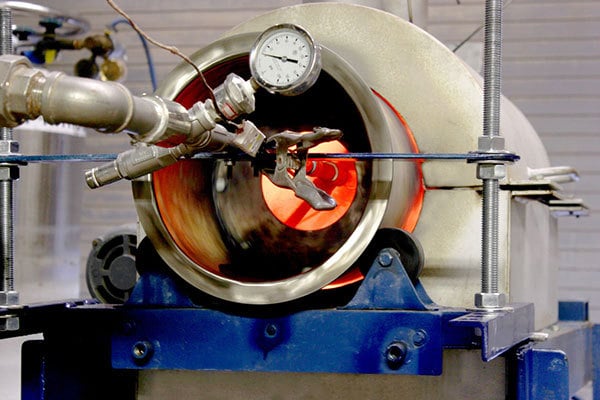
Indirect batch kiln testing in progress
Enabling Confident Scale-Up
One of the most important outcomes of testing is the ability to confidently scale from laboratory or pilot conditions to commercial production.
Without testing, producers risk:
- Incorrect equipment sizing
- Inefficient energy usage
- Inconsistent product quality
- Unexpected operational challenges
In contrast, producers that utilize testing tend to gain:
- Verified process parameters
- Representative material performance data
- A validated foundation for equipment sizing and design
- Reduced commissioning time and risk
Given the growing demand for high-performance graphite, particularly in applications where specifications are unforgiving, this foundational data is key to developing a reliable operation that consistently meets expectations.
The FEECO Innovation Center Advantage
The FEECO Innovation Center provides a competitive advantage for graphite producers looking to test and optimize their processes across key areas of production.
By integrating multiple testing capabilities under one roof, FEECO enables producers to evaluate how each component interacts with the next and how each step can be optimized to improve the entire production line—an essential consideration in graphite processing, where upstream decisions often have downstream consequences.
Throughout testing, small samples can be produced for downstream testing and validation, giving producers a further outlet for derisking scale-up.
Conclusion
As graphite demand continues to rise, driven by electrification, energy storage, and advanced materials, the margin for error in processing continues to shrink.
Material variability, stringent product specifications, and complex flowsheets all point to the critical role of process development test work in every aspect of production.
By leveraging the comprehensive capabilities found in the FEECO Innovation Center, graphite producers can not only optimize their new or existing process, but can also reduce scale-up risk and ensure their operation meets performance and quality expectations.
For more information on the Innovation Center, or to schedule a test, contact us today!
