

The growing need for titanium dioxide (TiO2) processing is welcome news to producers; a recent market analysis concluded that the titanium dioxide market will see a compound annual growth rate (CAGR) of over 7% between 2026 and 2034, driven by rising demand for paints, coatings, and a number of other applications.[1]
However, this growth also puts increasing pressure on producers using the primary approach to TiO2 production—the sulfate method—to find a solution to red gypsum, the waste material produced in substantial quantities alongside TiO2. With several challenges to overcome as scientists continue to explore promising options, thorough process development will be critical to bringing these new processes to commercialization.
What is Red Gypsum?
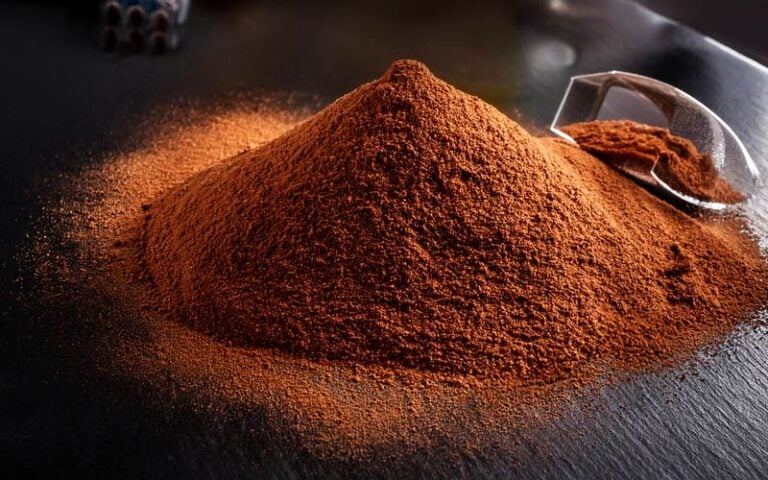
Also known as titanogypsum or titanium gypsum, red gypsum is a form of synthetic gypsum produced when ilmenite ore (FeTiO3) is treated with sulfuric acid to produce titanium dioxide. This reaction yields substantial quantities of an acidic wastewater byproduct known as titanium white waste acid, or TWWA. To manage this waste, producers treat TWWA with lime, which effectively neutralizes the material, but in turn yields red gypsum—a gypsum-rich byproduct in the form of a sludge. For every ton of titanium dioxide produced, experts estimate that the sulfate process generates between 6-10 tons of red gypsum.
Considering that 2024 estimates for global TiO2 production approached 10 million tons, the corresponding production of red gypsum is alarming.
While the sulfate method is the primary approach to manufacturing TiO2, it’s worth noting that the alternative—the chloride process—does not face this issue, because it does not employ the use of sulfuric acid, which requires subsequent neutralizing. However, the chloride process faces challenges that economically favor the sulfate process, leaving some researchers to explore the use of sulfuric acid alternatives to mitigate this growing waste management challenge.
Why is Red Gypsum a Problem?
Red gypsum is primarily composed of calcium sulfate dihydrate, as well as TiO2, silica, iron and aluminum oxides, and trace metal impurities. While not typically categorized as a hazardous waste, red gypsum still holds the potential for various risks, particularly given the quantity at which it is produced.
With tens of millions of tons generated annually around the globe, red gypsum requires significant swaths of land for landfilling or stockpiling, storage techniques which often lead to contamination of land, water, and air.
Researchers have long been on the hunt for improved management methods, but thus far have been unsuccessful in finding a solution that not only recovers the value contained within red gypsum, but that can also be effective at the scale required.
The U.S., among other nations, has declared titanium a critical mineral, signaling federal support for production and recovery efforts. As demand for titanium dioxide continues to rise, finding better management alternatives is becoming increasingly imperative.
Options for Valorizing Red Gypsum
Like other forms of synthetic gypsum, red gypsum holds numerous opportunities for potential reuse and recovery applications. The most widely explored are outlined here.
Iron Recovery
Red gypsum holds a high portion (5-15%) of iron hydroxide, which lends its characteristic red color and presents the opportunity to utilize red gypsum as a secondary source of iron.
One especially promising technique being explored is the use of TWWA as a leaching agent to extract iron from red gypsum, effectively using one waste to treat another.[2]
One study took this approach a step further, treating the now “white” (iron removed) titanium gypsum to produce a α-hemihydrate gypsum, which can be used in high-performance construction materials.[3]
Building Products
Numerous studies have explored the use of both treated and untreated red gypsum in building and construction materials, particularly in relation to cement binders, with encouraging results.[4]
Ceramics
Red gypsum has also been shown to be effective as a more sustainable alternative to natural gypsum in the industrial ceramics industry, capable of serving in both ceramic bodies and glazes. In some cases materials were able to use up to 70% red gypsum in their composition.[5]
Carbon Sequestration
Thanks to its high calcium content, scientists have also been exploring red gypsum as a way to sequester carbon through mineral carbonation. Several studies have shown this to be an effective approach that would not only alleviate waste management challenges, but would also help to make much-needed progress toward climate goals.[6]
Soil Amendment & Remediation
Both natural and synthetic gypsum are widely used as soil amendments in agriculture and turf applications to provide calcium and sulfur, as well as offer benefits such as improved aeration. Researchers are particularly hopeful that red gypsum could also act as a mobilizer of heavy metals in soil.[7]
One study found that when applied to heavy metal-contaminated paddy soils, red gypsum significantly lowered the bioavailability of cadmium, lead, and arsenic.[8]
Polymer Composites
Red gypsum is also being investigated for use as a filler and pigment in polymer matrices. The material could help to enhance properties in resulting products while also reducing the amount of plastic required.[9]
Challenges in Processing Red Gypsum
Although the reuse of other types of synthetic gypsum is already well established, red gypsum’s specific qualities mean existing solutions cannot directly translate.
With its high iron content, the presence of trace metals, and mechanical properties that do not lend well to all applications, red gypsum introduces new challenges requiring further investigation to ensure suitability in specific use cases.
In the construction industry, for example, a high iron content can discourage use, as the presence of iron can lead to staining when exposed to moisture.
Commercializing Red Gypsum Reuse Relies on Process Development
While more research is needed, the growing body of information around valorizing red gypsum continues to grow. The challenge now lies largely in closing the gap between concept and commercial viability, where most efforts unfortunately fail.
As scientists and industrial experts continue to explore use cases and trial concepts, facilities like the FEECO Innovation Center will be critical in bridging the path to commercialization.
From producing granular soil amendment samples for field trials to calcining red gypsum for use in construction materials, the Innovation Center offers several batch- and pilot-scale testing capabilities for the many processes that will likely be required in converting this material into usable forms:
Drying
No matter what application a producer intends on, drying red gypsum will be a likely first step, as the high water content of the byproduct makes it difficult to handle and costly to transport. Further, drying is often required for downstream processing to improve flowability and avoid clogging equipment.
The Innovation Center offers testing options for both rotary and fluid bed drying, allowing producers to establish the most effective approach to drying, as well as build data such as temperature profiles, residence time, internal configurations, and other critical drying parameters.
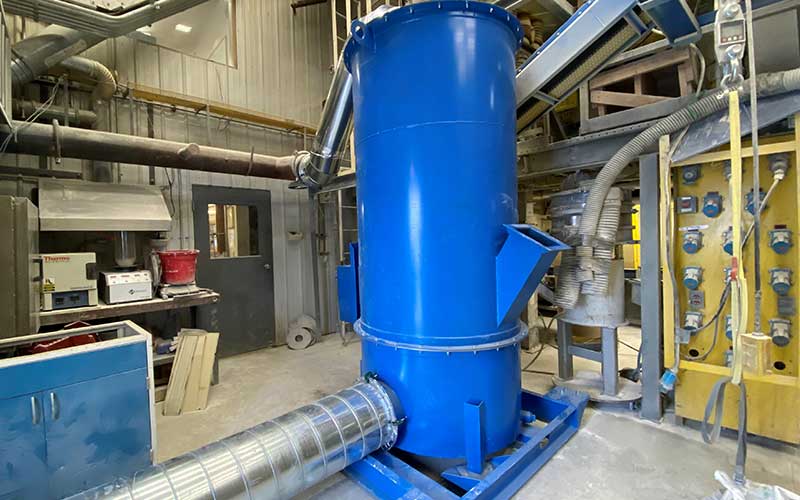
Pilot-scale fluid bed dryer
High-Temperature Thermal Treatment
High-temperature thermal treatment such as calcination and roasting is also likely to be employed in many applications, facilitating the phase changes and chemical reactions necessary to control the physical and chemical properties of red gypsum for downstream applications.
Both direct- and indirect-fired rotary kilns are available for batch and pilot testing in the Innovation Center to establish data such as residence time, temperature profiles, off-gas treatment, and kiln configuration.
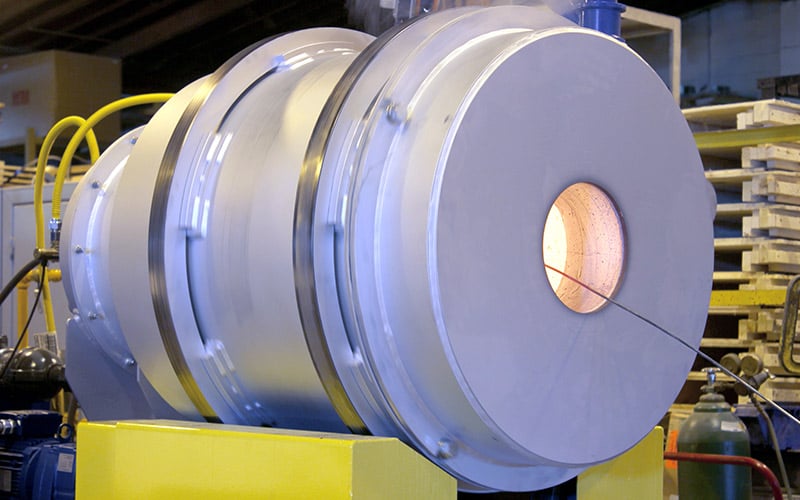
Direct-fired batch kiln used for thermal testing in the Innovation Center
De-dusting, Conditioning, and Mixing
De-dusting, conditioning, and mixing are essential steps for minimizing the dust, product loss, and housekeeping issues associated with powder handling.
The Innovation Center is equipped for testing pin and pugmill (paddle) mixers so producers can evaluate either technology to establish the mixer configuration that will consistently produce the properties they’re looking to achieve. Various binders can also be tested to aid in selection.
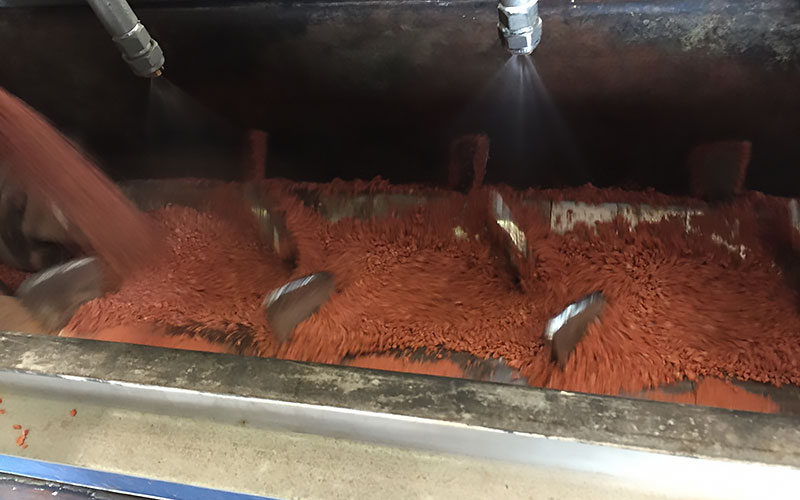
Paddle mixer testing in progress
Pelletizing/Wet Granulation
Pelletizing or wet granulation will be vital to producing flowable fillers, chemical compounds, and soil amendments that meet performance and handling expectations.
Several agglomeration equipment configurations can be tested in the Innovation Center to hone in on the process required to produce the target combination of bulk density, crush strength, attrition, and other essential particle characteristics.
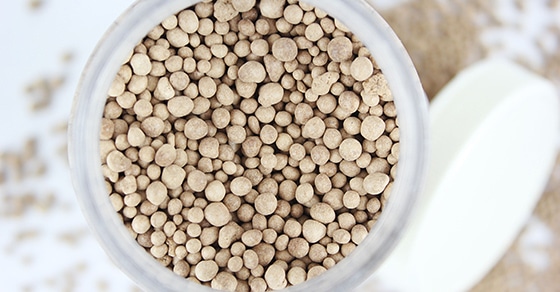
Pelletized FGD Synthetic Gypsum produced in the FEECO Innovation Center
Coating
Particle coating is widely used to adjust formulations and control particle characteristics for various application-specific objectives. While producers can test various types of coatings in the Innovation Center, success lies in establishing a coating drum configuration that will ensure particles are coated as uniformly and consistently as possible.
Whether drying, agglomerating, or otherwise, the comprehensive testing capabilities available in the Innovation Center allow producers to not only illustrate proof of concept and proof of product, but also demonstrate proof of process, as well as optimize the intended process or product, gathering the data they need for scale-up along the way.
Conclusion
With global production volumes continuing to rise, the window for proactive red gypsum solutions is narrowing, and the producers who move first on valorization stand to gain a meaningful competitive edge.
What’s needed now is the engineering work to bring the science to commercial fruition. That means rigorous process development—drying, thermal treatment, granulation, and beyond—carried out at a scale that generates real, bankable data.
FEECO has spent decades bringing processes from concept to commercialization across industries ranging from fertilizers and minerals to chemicals and industrial byproducts. From batch testing through pilot scale, as well as custom equipment manufacturing, FEECO brings together the testing infrastructure and hands-on engineering expertise to move red gypsum from a liability to a product. To learn more about testing in the Innovation Center, or to schedule a test, contact us today!
SOURCES:
- Fortune Business Insights. (2026, March 30). Titanium dioxide market size, share: Growth report [2034].
- Lin, Y., Sun, H., Zhao, Q., Jiang, L., & Peng, T. (2026). Titanium white waste acid for efficient iron removal from gypsum: A study on leaching kinetics and a sustainable “utilizing waste to treat waste” strategy. Journal of Environmental Chemical Engineering, 14(3), 122430. https://doi.org/10.1016/j.jece.2026.122430
- Wang, Y., Xiang, M., Yi, J., Wang, Y., Tang, W., Zhong, Y., Meng, H., Ma, X., & Chen, Z. (2025). Sustainable treatment of solid titanium-gypsum-waste using acidic titanium-white-wastewater to produce high-value α-hemihydrate gypsum. Hydrometallurgy, 235, 106489. https://doi.org/10.1016/j.hydromet.2025.106489
- Sotiriadis, K., Kiyko, P. I., Chernykh, T. N., & Kriushin, M. V. (2024). Self-cleaning ability of gypsum-cement-pozzolan binders based on thermally processed red gypsum waste of titanium oxide manufacture. Journal of Building Engineering, 87, 109009. https://doi.org/10.1016/j.jobe.2024.109009
- Marian, N. M., Perotti, M., Indelicato, C., Magrini, C., Giorgetti, G., Capitani, G., & Viti, C. (2023). From high-volume industrial waste to new ceramic material: The case of red gypsum muds in the TiO2 industry. Ceramics International, 49(10), 15034–15043. https://doi.org/10.1016/j.ceramint.2023.01.086
- Azdarpour, A., Afkhami Karaei, M., Hamidi, H., Mohammadian, E., & Honarvar, B. (2018). CO2 sequestration through direct aqueous mineral carbonation of red gypsum. Petroleum, 4(4), 398–407. https://doi.org/10.1016/j.petlm.2017.10.002
- Peacock, S., & Rimmer, D. L. (2000). The suitability of an iron oxide-rich gypsum by-product as a soil amendment. Journal of Environmental Quality, 29(6), 1969–1975. https://doi.org/10.2134/jeq2000.00472425002900060033x
- Fauziah, I., Zauyah, S., & Jamal, T. (1996). Characterization and land application of red gypsum: A waste product from the titanium dioxide industry. Science of the Total Environment, 188(2–3), 243–251. https://doi.org/10.1016/0048-9697(96)05179-0
- Pedrotti, C., Rossi, D., Sandroni, M., Anguillesi, I., Riccardi, C., Leandri, P., Cappello, M., Filippi, S., Cinelli, P., Losa, M., & Seggiani, M. (2025). Valorisation of red gypsum waste in polypropylene composites for agricultural applications. Polymers, 17(13), 1821. https://doi.org/10.3390/polym17131821
