


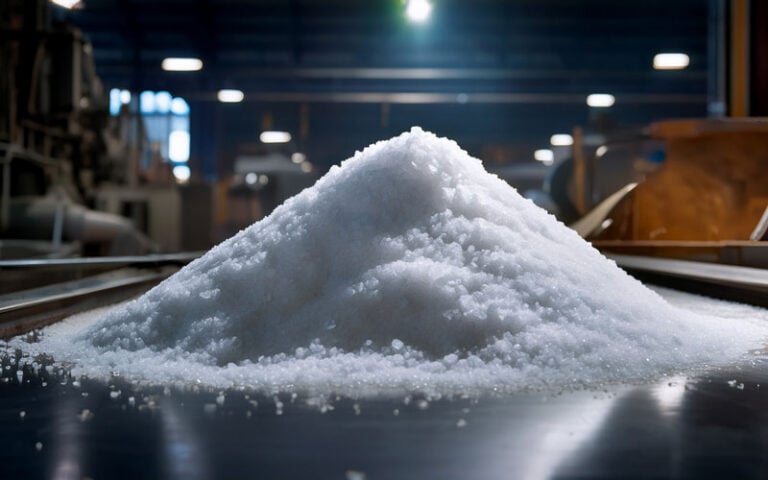
An industrial byproduct from the lithium battery industry is putting increasing pressure on producers to find an economic and sustainable outlet for mounting quantities of waste; as the battery industry continues to grow, along with it grows the production of sodium sulfate.
With research underway, a surprising solution could be on the horizon: conversion to potassium sulfate fertilizer.
What is Sodium Sulfate and Why is it a Problem?
Sodium sulfate (Na2SO4) is an inorganic salt used in a variety of products ranging from detergents and soaps to pulp and paper applications, as well as in consumer products. This soluble white material is produced both from naturally occurring sodium-sulfate bearing sources and as an industrial byproduct. Recently it’s been gaining attention for its generation in the lithium battery industry.
The lithium battery industry is seeing staggering growth to meet increasing demand in everything from electronics to electric vehicles and energy storage systems. Fortune Business Insights recently reported they expect the market to experience a compound annual growth rate (CAGR) of 22.85% between 2026 and 2034.[1]
Sodium sulfate is produced at multiple points in the lithium battery lifecycle: Key generation points include:[2]
- Lithium hydroxide monohydrate (LiOH·H₂O) production: reacting lithium sulfate (Li₂SO₄) with sodium hydroxide (NaOH)
- Precursor cathode active material (pCAM) manufacturing: converting and neutralizing metal sulfates generates sodium sulfate-laden wastewater
- Battery recycling (hydrometallurgical routes): leaching and purification stages produce Na₂SO₄-containing effluents
The generation of sodium sulfate from the battery industry is not new; it has long been produced as a result of the recycling of traditional lead-acid batteries.
However, given that sodium sulfate is produced at multiple stages throughout the lifecycle of lithium-ion batteries, burgeoning production is yielding sodium sulfate in unprecedented quantities. For every ton of lithium hydroxide, an estimated 2-2.5 tons of sodium sulfate is also produced.[3]
Treatment Options
Historically, sodium sulfate has been diverted to markets that can utilize it. And while this has been effective, the quantities coming out of the lithium battery industry simply cannot be absorbed by traditional markets.[2]
Produced as a wastewater effluent, one option has been to discharge sodium sulfate into waterways, but growing environmental concerns have put this approach to waste management under a microscope; high levels of sulfates can be detrimental to aquatic ecosystems, killing off plants and fish, as well as causing algal blooms.
Concern over this put the opening of a precursor cathode active material (pCAM) plant in jeopardy in Finland. Local authorities and environmental groups challenged the plant’s plan to discharge their effluent into the nearby river, which would have increased sulfate concentration. Plant commissioning was ultimately postponed until the company could build an on-site crystallizer to extract and recover sodium sulfate.[2]
Landfilling sodium sulfate is also utilized as a waste management approach, but given its highly solubility, careful management is required to prevent sodium sulfate from leaking into soil and groundwater, not to mention that the general practice of landfilling is increasingly falling out of favor.
The problem is leading battery chemical producers and recyclers to explore a number of options to mitigate sodium sulfate management challenges, all of which are in nascent stages. At present, the most economically attractive approach to managing the byproduct is to convert it to a potassium sulfate (K2SO4) fertilizer.[2]
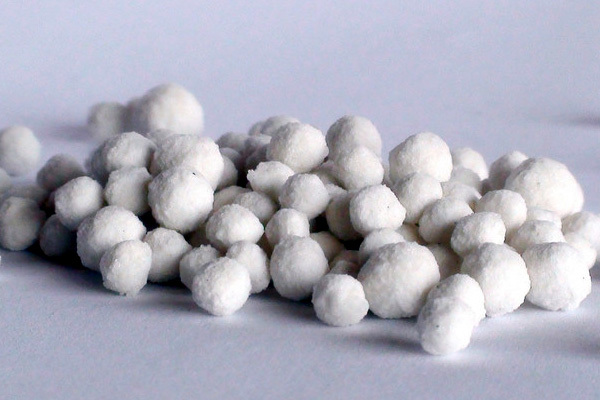
Granular SOP fertilizer produced in the FEECO Innovation Center
The Potassium Sulfate (SOP) Fertilizer Opportunity
Potassium sulfate, or SOP (sulfate of potash), is widely used in the fertilizer industry for high-value crops that cannot tolerate the higher chloride levels present in potassium chloride (muriate of potash/MOP or KCl). Unlike potassium chloride, potassium sulfate also serves as an essential source of sulfur and offers lower salinity. For these reasons, as well as the growing need for more specialized crop nutrient management, potassium sulfate has seen increasing use in recent years, and it sells at a premium price.
The ability to convert sodium sulfate waste into a premium-quality fertilizer would not only alleviate waste management challenges for lithium producers, but would also create an additional revenue stream and provide a new source of this increasingly essential fertilizer.
One company, Cinis Fertilizer, is successfully doing this already.
How Does the Sodium Sulfate to Potassium Sulfate Process Work?
Details around Cinis’ production process are sparse, but research has largely centered around a metathesis approach, reacting sodium sulfate with potassium chloride to produce glaserite, a mixed potassium sulfate salt from which potassium sulfate can be precipitated or crystallized into a solid, leaving behind a potassium chloride brine.
A 2022 patent describes the conversion process via ion exchange technology, using a soluble sulfate contacted with potassium chloride to yield a mixed potassium sulfate/potassium chloride brine from which potassium sulfate can be recovered as a solid. The remaining potassium chloride brine can be recycled back into the process.[4]
It is worth noting that a reliable source of potassium chloride (KCl) will be necessary in such conversion processes, adding to costs and the complexities of logistics. For battery chemical producers evaluating this conversion route, proximity to KCl supply chains and acquisition cost should be evaluated as part of a cost analysis to avoid eroding the advantage of selling SOP at a premium.
A similar argument can be made for co-locating fertilizer plants and battery facilities, as transporting sodium sulfate, whether as a wet slurry or evaporated crystalline solid, is costly.
Cinis is currently producing near-fossil-free potassium sulfate fertilizer, sourcing some of their sodium sulfate from a nearby Northvolt battery production facility. In addition to utilizing waste materials, the company’s process requires just half the energy of traditional production methods, making a powerful case for the economics of both the conversion concept and facility co-location.[5]
Achieving a Market-Ready Fertilizer Relies on Solid Process Development
Once extracted, solid K2SO4 can either be dried and sold in its current form, or granulated into a premium granular product. As with any new feedstock source, thorough process development testing is essential to yielding a process that consistently meets product quality specifications. It’s also important to recognize that trace metals and impurities remaining in potassium sulfate sourced from the battery industry specifically could complicate downstream processing or require additional purification steps to meet the heavy metal limits and purity thresholds set by fertilizer market regulations.
Controlled drying is likely to be crucial to preparation for market whether potassium sulfate is used as-is or granulated. In addition to reducing transportation costs, uniform drying ensures flowability and shelf stability, while also maintaining product integrity throughout storage and use. If the material will undergo further processing, consistently reaching a target moisture content is pivotal to efficient downstream processing.
Drying may be carried out in a rotary dryer or fluid bed dryer, with the dryer type, and the configuration of that dryer depending on the specific material characteristics and throughput requirements.
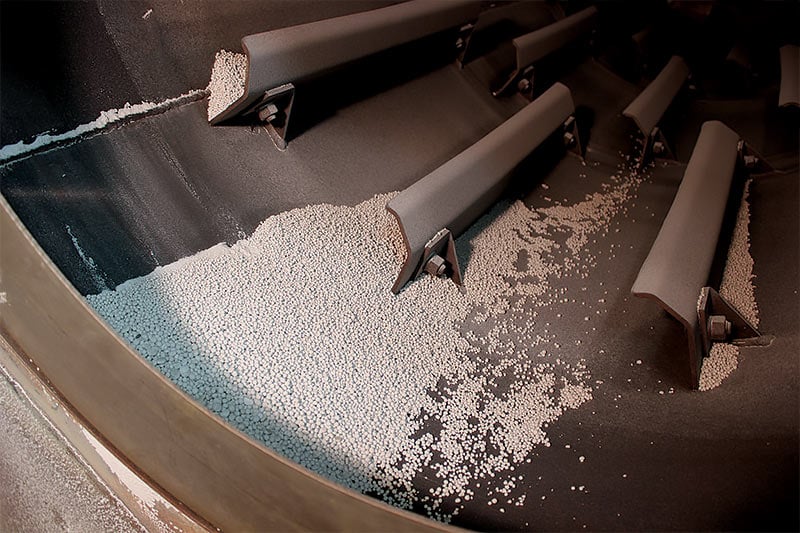
Granular potash in the Innovation Center’s pilot-scale rotary dryer
For producers targeting the premium market, granulation adds significant value, but also introduces additional complexities.
Fertilizer distributors and end users strongly prefer granular SOP over powder form: granules flow predictably through standard application equipment, resist dusting and caking during storage and transport, and can command a higher price per ton.
However, as with drying, achieving a consistent, market-ready granule requires careful process development. Key variables include binder selection and application rate, feed moisture control, recycle ratio management, and establishing minimum crush strength to ensure granules survive handling and storage without degrading.
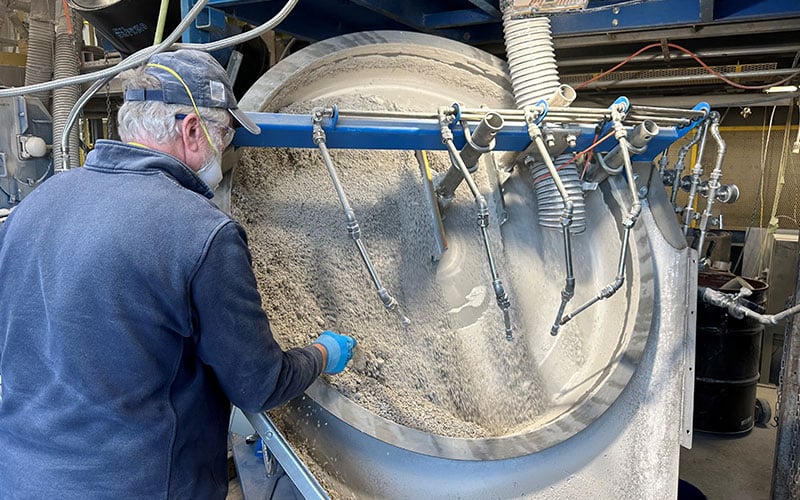
A process expert evaluates material on a disc pelletizer during process development
Because these parameters interact with each other, defining the variables necessary to consistently yield product according to spec is critical, otherwise risking re-processing, lost product, and dust generation, among other issues. This type of reliability can only be established through testing to develop representative, real-world data.
The Innovation Center Advantage
Backed by over 75 years of experience in traditional and novel fertilizer production techniques, The FEECO Innovation Center offers fertilizer producers a competitive advantage in bringing their products to market.
The facility is equipped for testing both rotary and fluid bed dryers, as well as refining process and dryer configuration to optimize for uniform, efficient drying. This includes establishing key process parameters such as:
- Temperature profiles
- Retention/Residence time
- Drum slope and speed
- Volumetric fill
- Air flow
- Feed and product rates
With an extensive list of batch- and pilot-scale equipment, producers can also test mixing, conditioning, wet granulation, and coating, either as standalone processes, or as part of a continuous process loop with drying and recycle.
Conclusion
Pressure around managing the sodium sulfate challenge is intensifying for battery producers, especially as gigafactory buildout accelerates and regulators tighten effluent discharge standards. The conversion to potassium sulfate fertilizer represents a commercially compelling answer to that challenge, offering waste diversion, revenue generation, and supply-chain contribution to food security.
But the path from Na₂SO₄ waste stream to market-ready SOP fertilizer is not a simple one. Feedstock purity, drying behavior, and granule quality all require rigorous process development before a commercially viable operation can be established. Early-stage testing in a controlled environment—working through dryer configuration, moisture targets, granule characteristics, and recycle ratios—provides the foundation necessary for a commercially successful operation.
For producers ready to explore this route, the FEECO Innovation Center offers the testing infrastructure and process expertise needed to move from proof of concept to proof of process and finally, process and product optimization. With a dedicated testing facility and over 75 years of experience building custom fertilizer granulation systems, FEECO is positioned to help battery chemical producers not only uncover the process needed to unlock the value contained in their sodium sulfate waste stream, but to build the commercial-scale equipment to make it possible. For more information on the Innovation Center or our custom equipment, contact us today!
SOURCES:
- Fortune Business Insights. (2025). Lithium-ion battery market size, share, growth drivers & trends report, 2034. https://www.fortunebusinessinsights.com/industry-reports/lithium-ion-battery-market-100123
- Olchowka, J., & Tassel, C. (2025). Valorization pathways for sodium sulfate: Addressing one of the most abundant by-products of the battery industry [Preprint]. ChemRxiv. https://doi.org/10.26434/chemrxiv-2025-lzph8
- Dara, S. (n.d.). Sustainable lithium refining for a greener battery-value chain. Clean50. https://clean50.com/sustainable-lithium-refining/
- Fraser, R. J., & Stamatiou, E. (2023). Sodium sulfate by-product processing in lithium and battery chemical production (U.S. Patent No. US20230052881A1). U.S. Patent and Trademark Office. https://patents.google.com/patent/US20230052881A1/en
- Cinis Fertilizer. (2024). Input materials in place ahead of Cinis Fertilizer’s start of production [Press release]. https://www.cinis-fertilizer.com/media/press-releases/2024/input-materials-in-place-ahead-of-cinis-fertilizers-start-of-production/

