


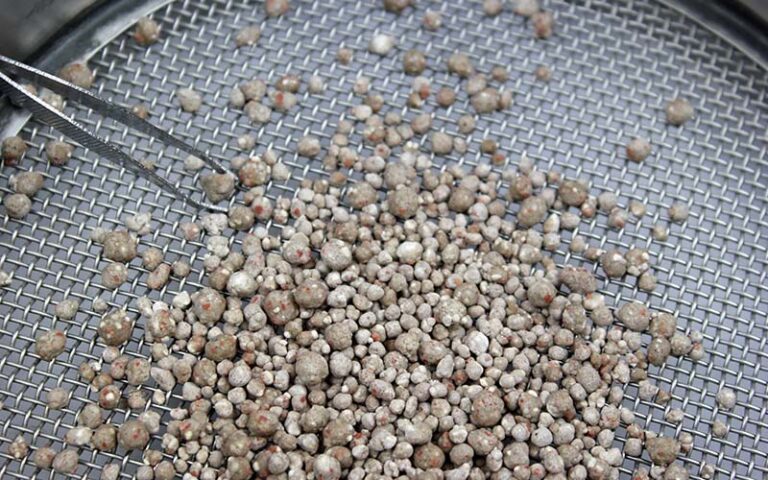
While fertilizer production is a well-established industry, many questions arise in the design of a fertilizer granulation plant. As new and existing producers aim to meet increasingly specialized crop nutrient demands, transform waste materials and by-products into value-added products, and utilize novel source materials, these old questions are taking on new meaning.
As a leader in traditional and custom fertilizer granulation since 1951, we’ve spent decades helping our customers to design granulation plants that meet their specific process and product goals. From equipment selection and binder requirements to quality control (QC) protocols, we’re answering the questions that shape successful granulation plant design today.
Which equipment setup is best for my product?
The granulation equipment setup best suited for a given product line depends on the material feedstock, process goals, and product quality requirements. Several equipment options are available and can be combined to produce the desired results:
- Granulation Drum
- Disc Pelletizer (also commonly referred to as a pan granulator)
- Pin Mixer
- Pugmill Mixer (also commonly referred to as a paddle mixer or pug mill)
The combination of a pin mixer and disc pelletizer offers tight particle size control and a refined granular product, while a granulation drum yields a less refined granular product but at a higher throughput. A pugmill mixer in isolation provides mixing and rough granulation, while a pin mixer is capable of mixing and producing dense micro pellets. The addition of a coating drum in any of these configurations can be used to apply additional micronutrients, anti-caking agents, or other finishing treatments.
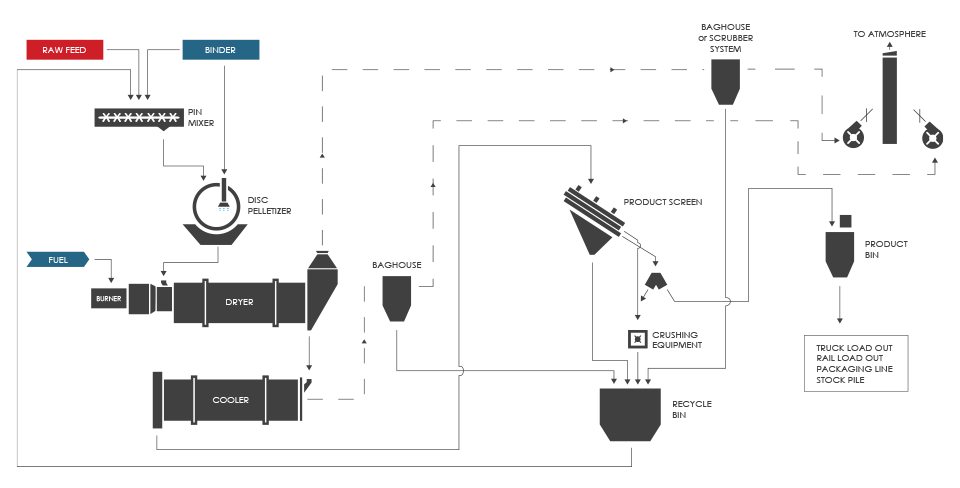
A typical granulation setup using a pin mixer and disc pelletizer, followed by drying, cooling, screening, and recycle.
If the most suitable equipment configuration is not readily apparent, the best approach can be determined through batch-scale testing in a facility such as the FEECO Innovation Center. Here, process experts can determine which equipment and configuration will work with the feedstock characteristics to produce the desired product quality.
Do I need a binder?
The need for a binder depends on the type of fertilizer being produced.
Ammoniated phosphates (MAP, DAP) do not require the addition of a binder, because the chemical makeup itself provides a binding effect.
Other types of fertilizers being produced using the wet granulation technique will typically require a binder to facilitate granule formation and growth while also contributing to green (wet pellet) strength and end product crush strength.
Fertilizer producers have a number of binder options at their disposal. Common options include water (for soluble materials), lignosulfonates, starches, bentonite clay, and synthetic polymers, each offering different trade-offs in cost, dosage rate, and green strength.
Producers can use the Innovation Center to test different binder types, as well as binder concentration and delivery methods to establish the most effective approach.
Do I need to dry the pellets after granulation (green pellets)?
Yes. The requirement of a liquid binder for granule formation necessitates a subsequent drying step to ensure product meets target moisture requirements for handling, storage, and shelf stability. Proper drying lowers shipping costs, helps to prevent product caking and bacterial formation, and maintains product integrity so fertilizer can perform as intended in the field.
Target moisture is typically between 2-3% by weight and can be achieved using either a fluid bed or rotary dryer.
Will there be any recycle?
Yes. Achieving 100% on-size product yield in a single pass is not practical at commercial scale, making a recycle stream a necessary part of every granulation circuit.
Strategic design of the recycle loop is a powerful tool in optimizing production efficiency and providing a buffer in times of fluctuation. See How Process Recycle Loops Drive Yield, Stability, and Product Quality >>.
How many operators do I need?
The number of operators depends on the type of equipment in use and the amount of throughput. Most plants utilize one operator and one supervisor. However, because disc pelletizers require more supervision, plants utilizing several discs benefit from having more than one operator.
Labor requirements also depend on material feed and offtake, with non-automated systems (ex., front-end loader feeding) requiring additional labor. Most single-line plants operate with 2–6 total personnel per shift including operator, supervisor, and material handling support.
How tall does my building need to be?
Required building height depends on several factors, including equipment layout, potential for expansion, and plant capacity. Building height is one of the most consequential design parameters of a wet granulation facility, with ramifications on capital cost, operational efficiency, equipment (maintenance) accessibility, and even product quality.
Building height must be carefully considered, as insufficient height can force suboptimal equipment arrangement, shortening retention time in the dryer or cooler and compromising product moisture and strength.
A large-scale production facility with a capacity between 20-50 TPH may require a height anywhere between 100’ – 140’.
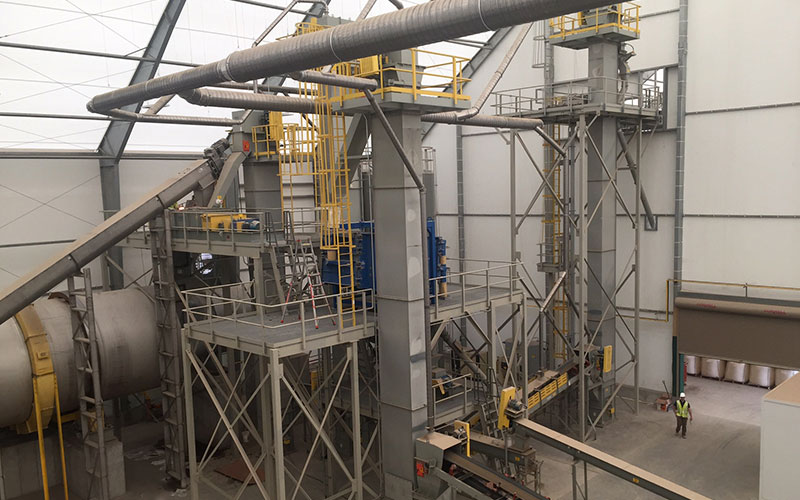
FEECO fertilizer granulation plant
What footprint will my granulation plant require?
Plant footprint is the result of several parameters and plays a deciding role in facility cost. Several aspects of plant design play into total footprint, with equipment layout, material flow, and shipping access having significant implications.
For a plant with a capacity of 20-50 TPH, footprint could be anywhere between 20,000 and 50,000 sq. ft. This footprint typically covers the main process building and excludes raw material receiving, bulk storage, and finished product warehousing, which can significantly increase total site area.
How finely do my feed materials need to be ground?
Feed materials must be ground to achieve a particle size distribution (PSD) in which all material is below 250 micron, though this target can change depending on the material’s unique characteristics.
Within the defined PSD, FEECO recommends achieving a diverse cross section of particle sizes to encourage stronger granules with fewer void spaces. Over-grinding to a uniform powder must be avoided, as it reduces granulation efficiency.
Grinding is typically carried out in a hammer mill.
How can I de-risk the scale-up process?
De-risking the scale-up process is achieved by conducting thorough process development testing. The FEECO Innovation Center offers fertilizer producers the opportunity to simulate process conditions and test their process configuration on a continuous pilot scale.
This type of testing establishes the basic criteria needed for continuous operation on a commercial scale, while also identifying potential issues prior to scale-up, significantly reducing risk on the path to commercial-scale production. For example, pilot testing can reveal whether a feedstock’s variable moisture content will cause surges in the recycle loop—a problem far less costly to address at pilot scale than after commissioning.
What sort of maintenance will the granulation system require?
Granulation system maintenance differs depending on the type of materials in use, equipment selection, and operating conditions. High-throughput plants operating around aggressive production schedules are likely to require more frequent maintenance than a specialty fertilizer plant operating on a seasonal basis.
Primary maintenance concerns center around maintaining proper lubrication on all equipment, keeping rotary drums in proper alignment, grinding tires and trunnions as needed, and replacing internal components as needed. Regular inspections by on-site personnel, as well as annual inspections by the OEM, play an outsized role in identifying and preventing issues before they can escalate. Inspection frequency, as well as maintenance requirements, vary based on process conditions.
What does the product PSD need to be (how big)?
Particle size distribution (PSD) for the end product varies based on the target market (agronomic demands), blend partners, and chosen equipment.
Many producers choose equipment early and find out later that it dictates PSD yield. When this occurs, producers are limited in their PSD options and must evaluate the most marketable option based on what their equipment setup can produce.
Ideally, particle size distribution should be determined early in the process as part of a market analysis, and the front-end engineering design (FEED) based around this parameter (among others).
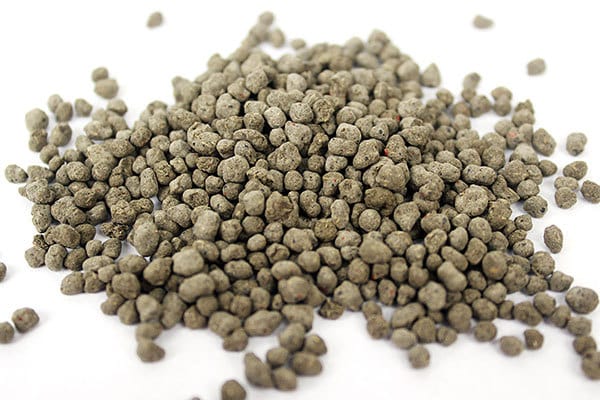
Granular manure-based fertilizer
What are my quality control (QC) checks?
Quality control checks for fertilizer products center around a few key granule characteristics, including attrition rate, crush strength, and bulk density, though this may vary based on facility and product goals.
Attrition Rate
By confirming attrition rate, producers can be confident that their product will generate a minimal amount of dust and fines during transport and storage.
An attrition rate as close to zero as possible is ideal, but not always attainable. For some fertilizers, an attrition rate below 10% may be sufficient, while for others 10% might be unacceptable.
Crush Strength
Regularly checking crush strength helps to ensure that product will not break down under loads or through transfer points.
A crush strength of 5 lb. or higher is optimal for meeting these specifications, as well as market requirements. Standards for MAP/DAP may differ.
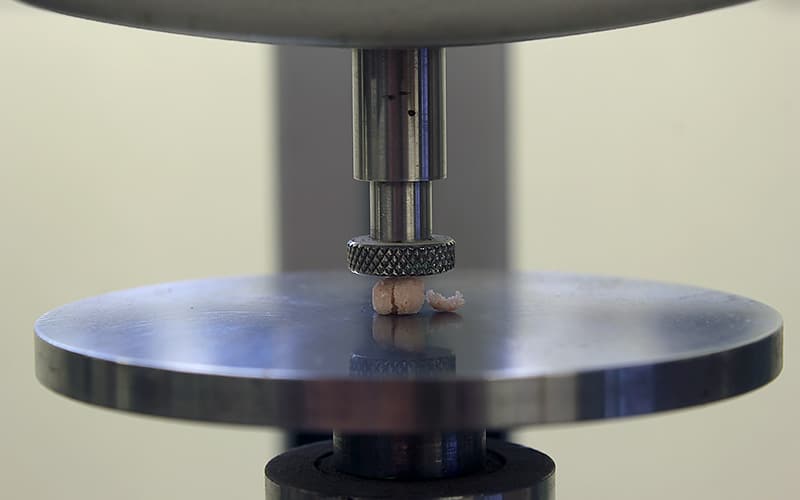
Crush strength test in progress in the Innovation Center
Bulk Density
Bulk density is an essential metric to confirm granules meet volumetric and shipping requirements, as well as performance expectations.
Target bulk density is highly variable, depending on the facility’s shipping infrastructure and product quality goals, but may range between 45–65 lb/cu. ft. depending on the formulation.
While attrition, crush strength, and bulk density represent the primary QC points, moisture content and sphericity are also essential parameters to monitor.
Conclusion
As novel source materials, waste-to-fertilizer projects, and changes in crop nutrient demand continue to inundate the market, deep expertise in fertilizer granulation has never been more important.
With batch- and pilot-scale testing capabilities and over 75 years helping fertilizer producers meet their objectives through process development services, custom equipment, and parts and service support, FEECO offers fertilizer producers a single, integrated resource for moving a project from idea to commercial-scale production. To explore our Innovation Center testing capabilities or speak with a process engineer about your specific feedstock, contact us today!

