


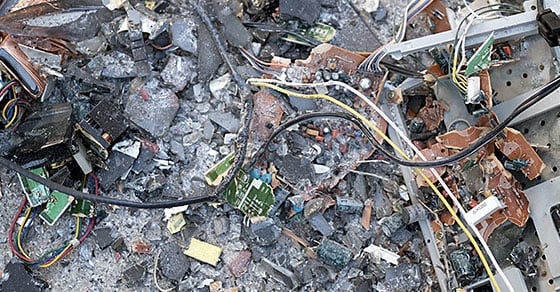
Metal recovery from spent batteries and other electronic wastes looks to be the next frontier in mining, as the world continues its search for a sustainable management solution for this rapidly growing category of waste.
From old cellphones, to TV’s, electric vehicle (EV) batteries, and everything in between, levels of electronic waste are reaching unprecedented heights. Combined with the growing need for building secure critical mineral supply chains, “urban mining” continues to gain traction. The rotary kiln, an advanced thermal processing device, is one of the primary technologies enabling recovery.
The Growing Sense of Urgency Around Electronic Waste
As the world becomes more technologically connected than ever, volumes of e-waste are surging. In 2019, the World Economic Forum (WEF) declared e-waste the fastest-growing global waste stream, having reached an alarming 48.5 million tons in 2018.[1]
Just four years later, the World Health Organization (WHO) estimated the world produced 62 million tons of e-waste, of which only 22.3% was confirmed recycled.[2]
Alongside this surging category of waste, nations are exploring every opportunity to obtain the critical minerals needed for energy and defense applications, amidst growing geopolitical challenges.
Paired with the rising demand for technology, this has prompted a growing sense of urgency for systemic change in the way the modern world approaches e-waste and the valuable finite resources we rely on.
Problems Surrounding E-Waste
E-waste presents several issues that make sustainable management a top priority. Poor management of e-waste:
Increases the Need to Mine Finite Resources
Rare earths, gold, palladium, copper, and more all reside within our cell phones, TVs, and batteries.
These valuable materials are acquired through intensive mining operations, which disturb land, produce wastes, and generate emissions. Recycling allows these valuable materials to be reused, reducing the need to mine additional virgin resources.
According to the EPA, the recycling of one million cell phones yields 35,000 lbs. of copper, 772 lbs. of silver, 75 lbs. of gold, and 33 lbs. of palladium.[3]
Encourages Hazardous Working Conditions
Despite efforts to thwart such practices, many outdated electronics end up in developing nations, where legislation around e-waste is lax or even non-existent. Here, workers sort through the products by hand or use crude processing methods to recover the desired components – a highly toxic endeavor.
A study by the Basel Action Network (BAN), in which GPS trackers were put on items of e-waste and then donated or brought to recycling centers, found that 40% of the items delivered to US recyclers were exported, 93% of which went to developing countries.[4]
Endangers the Environment
The toxic components in e-waste not only pose threats to workers in developing nations, but they also pose hazards to the environment; where e-waste is either improperly handled or disposed of, there is risk of soil and groundwater contamination.
Mercury, lead, cadmium, and other components have the potential to seep into soil and groundwater, contaminating these valuable resources.
Takes Essential Materials Out of the Value Chain
The disposal of such significant quantities not only causes environmental and social harm, but it also takes critical, finite resources out of the production value chain.
Not unlike the broken nutrient cycle in the agriculture industry, a closed-loop approach that extracts these valuable components for reuse is needed.
Rotary Kilns for Recycling E-Waste
While several options are being explored for managing e-waste more sustainably, pyrolysis, which is often carried out in a rotary kiln, holds several environmental advantages compared to other popular approaches. This includes improved recovery rates, fewer pollutants, and the opportunity to recover energy.[5]
The rotary kiln is a high-temperature thermal processing device employed to cause a chemical reaction or physical change in a material. Increasingly used in waste-to-value applications, rotary kilns volatilize the plastic and combustible components, leaving behind ash from which the metal(s) can then be leached. Electronic circuit boards, lithium batteries, and more, have all been effectively processed in a rotary kiln to recover metals such as lithium, copper, gold, nickel, and silver.
While alternatives to the rotary kiln are available, the advantage of the rotary kiln in this setting is that it is a truly continuous operation; other devices are batch style, requiring operators to load the system, run it, unload it, and then repeat the process. Rotary kilns are more efficient from an operational standpoint, because they avoid all of this; material is continuously fed into and discharged from the kiln, creating an efficient and high-capacity processing line.
E-Waste Kiln Design
Rotary kiln design is highly dependent on the make-up of the e-waste, the target metals to recover, and the anticipated pollutants. The kiln may be either of the direct-fired or indirect-fired configuration.
Direct-Fired Kilns
Direct-fired kilns employ combustion gases to process material through direct contact. This setup is more cost-effective and more efficient, but has a potential disadvantage: some of the metal can end up volatilizing with the combustible portion of the feed stream and exiting the system through the stack, resulting in some metal loss.
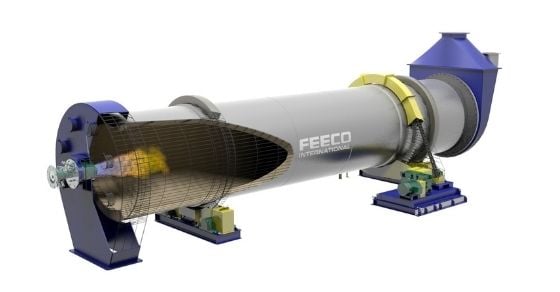
3D Rendering of a direct-fired kiln
Indirect-Fired Kilns (aka Calciners)
To combat these challenges, many producers opt for a true pyrolysis process, in which the material is heated in the absence of oxygen. This is carried out in an indirect-fired kiln, also often called a calciner. In this setting, heat is applied externally, so gases are kept separate from the material. Material is subsequently heated through contact with the shell of the rotating drum. This prevents the material from combusting, instead decomposing into the solid and any applicable liquids (bio-oil) or gases (syngas).
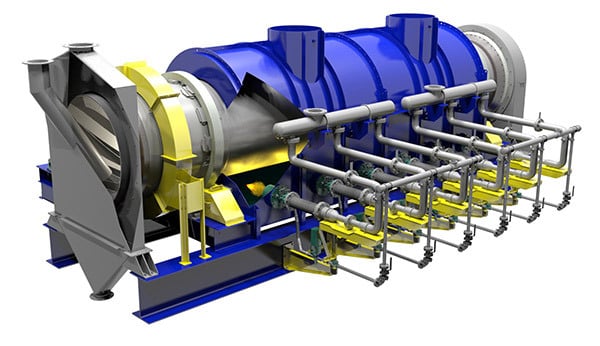
3D Rendering of an indirect-fired kiln
Although less thermally efficient, the use of an indirect kiln reduces the amount of metals lost to the stack. Additionally, the syn-gas generated can be used to fuel a fire in a boiler, to make steam, or even in a thermal oxidizer to generate a hot gas for heat recovery applications. When present, liquid bio-fuels can also be captured and utilized.
This approach, producing fuel alongside the leachable solids, has seen increasing interest among researchers.
With either configuration (direct or indirect), recovery and co-product generation is optimized through a variety of design considerations, which are determined through testing.
E-Waste Recycling Process Development
The variation across types and combinations of e-waste make testing in a facility such as the FEECO Innovation Center an essential part of developing a successful commercial-scale operation to recover metals. Several companies have used the Innovation Center to confirm proof of concept (feasibility), as well as test their waste on a continuous basis.
Several variables are refined during this time:
- Retention time
- Temperature profiles
- Rotational speed
- Feed rate
- Air flow velocity
- Off-gas analysis
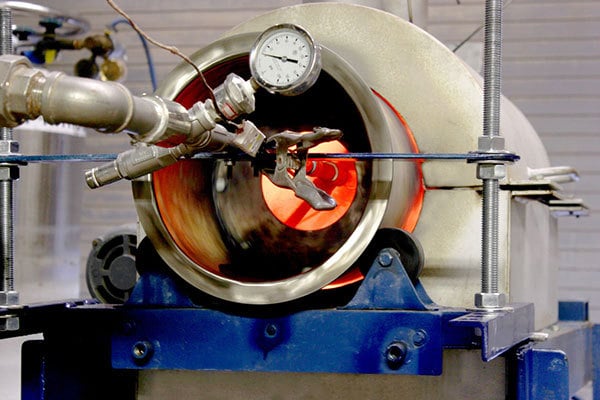
Indirect-fired batch kiln used for testing e-waste in the FEECO Innovation Center
FEECO uses the data gathered during testing to design a commercial-scale rotary kiln tailored to the waste source characteristics and the customer’s process goals.
Conclusion
The growing amount of e-waste produced each year is alarming and continues to draw concern, given the many environmental, resource, and social issues associated with its inadequate management.
The ability to recover critical materials from e-waste on a global scale would resolve these issues, while also keeping these much-needed resources in the production lifecycle. Rotary kilns offer a high-capacity, continuous, and optimized solution to achieve these goals.
With the help of our testing facility, FEECO engineers and manufactures custom rotary kilns for recovering metals from e-waste. We have worked with a number of successful metal recovery projects in the effort to more sustainably manage this ever-growing waste stream. For more information on our e-waste processing capabilities, contact us today!
SOURCES:
Image Source: takomabibelot, E-Waste in the Alley (Silver Spring, MD), Cropped by FEECO International, CC BY 2.0
- World Economic Forum. (2019). A new circular vision for electronics: Time for a global reboot. In support of the United Nations E-waste Coalition. https://www.weforum.org/publications/a-new-circular-vision-for-electronics-time-for-a-global-reboot/
- World Health Organization. (2024, October 1). Electronic waste (e-waste). https://www.who.int/news-room/fact-sheets/detail/electronic-waste-(e-waste)
- U.S. Environmental Protection Agency. (2025, December 19). Electronics donation and recycling. https://www.epa.gov/recycle/electronics-donation-and-recycling
- Hopson, E., & Puckett, J. (2016). Scam recycling: e-Dumping on Asia by US recyclers. Basel Action Network. https://wiki.ban.org/images/1/12/ScamRecyclingReport-web.pdf
- Almansoori, N. B., Bin Amro, A., Albreiki, J., Alkatheeri, M., & Amer, S. T. (2024). Feasibility and environmental impacts of pyrolysis for converting e-waste into energy. Proceedings of the 7th European Conference on Industrial Engineering and Operations Management. IEOM Society International.https://doi.org/10.46254/EU07.20240254

