


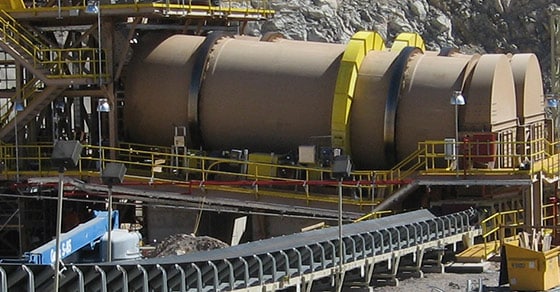
As global demand for metals increases and high-grade ore sources deplete, mining companies are turning to technologies like heap leaching to efficiently recover valuable metals from low-grade ores. NAUE, a group specializing in geosynthetic liners, assesses that over 30% of copper and gold produced each year is beneficiated via heap leaching, up from only about 3% just decades earlier.[1]
What the Heap Leaching Process Looks Like:
Heap leaching involves stacking crushed ore onto an impermeable surface, where it’s irrigated with a leaching agent. This solution percolates through the ore, chemically reacting to dissolve the target metal into an aqueous solution, which is collected for further processing.
Crushing & Agglomeration
In heap leaching, mined ore is first commonly crushed in order to make the target metal more accessible to the leachate. Ore sources coming from already crushed or pretreated sources, such as tailings, may not require additional crushing.
While the ore could be piled onto the heap for irrigation at this point, the incorporation of an agglomeration step has shown to significantly increase the effectiveness of leaching when fines are present.
By agglomerating the ore, fines are bound up and ore particle size distribution becomes more uniform. This prevents fines from clogging flow channels within the heap, leading to improved percolation of the leachate, as shown below.
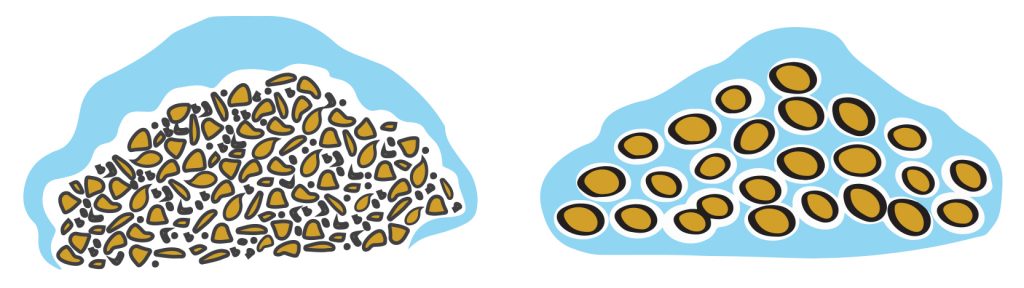
Agglomeration is carried out in an agglomeration drum (ore drum), in which the ore fines are tumbled and sprayed with the lixivant/leachate. The tumbling action, combined with the leaching agent, allows the ore fines to form into particles that are more uniform in shape and size.
This step also has the advantage of creating a homogenous mixture of the ore particles and leachate, ensuring maximum contact between the ore and leachate, as well as beginning the leaching process prior to the heap.
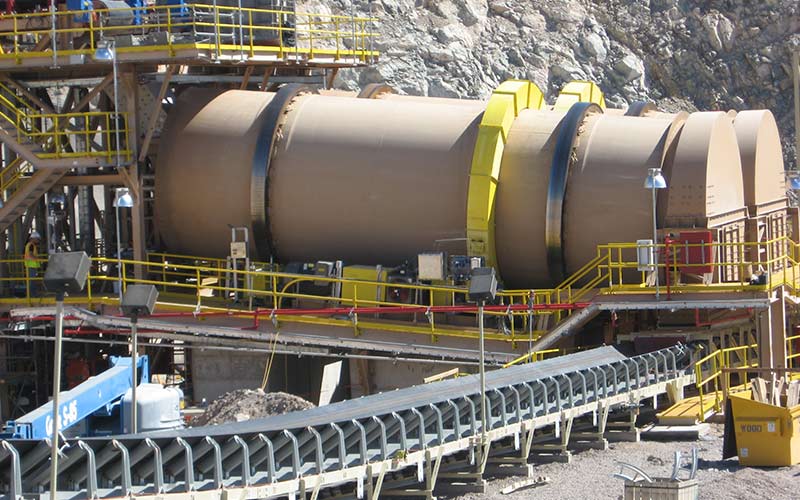
FEECO Agglomeration drums at a heap leaching operation
Stacking & Irrigation
Once crushed and agglomerated, ore is stacked onto an impermeable pad, creating the “heap.” The heap is then irrigated with the leaching agent, which differs depending on the target metal.
The leachate is allowed to percolate through the heap, during which time the target metal is dissolved into the aqueous solution through chemical reaction with the leachate. The impregnated solution is then collected at the bottom, where it moves on to metal extraction.
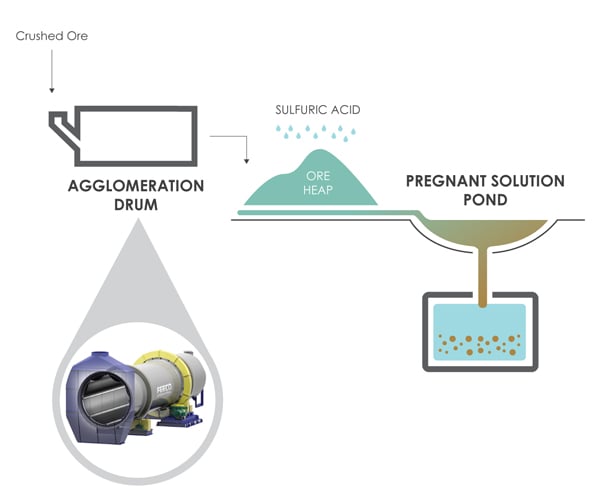
A simplified flow diagram of the heap leaching process for copper, with agglomeration pre-treatment incorporated
Benefits of Heap Leaching
The primary advantage of heap leaching is its applicability to low-grade ore sources, or those that are otherwise not economic to process via traditional mining techniques. Heap leaching is perhaps most recognized for its use in the copper industry, where it has facilitated the recovery of oxide ore sources not amenable to smelting.
As ore grades decline and easily accessible high-grade ores become depleted, mining low-grade ore sources is quickly becoming critical to meeting rising metal demand.
The heap leaching process can facilitate this recovery with various metals in settings both large and small, making it applicable in a wide range of operations. And, at a fraction of the cost of traditional mining techniques, heap leaching operations are much lower risk, making them a great fit for high-risk settings or those that may not justify the investment associated with traditional mining.
Heap leaching is considered a relatively low-tech process, so setup and operation are simple. Further, the technique requires less energy and water and can be employed across a range of climates.
The use of heap leaching also helps mining operations to reduce environmental impacts by minimizing waste and maximizing resource recovery. In contrast to conventional methods, heap leaching’s lower energy consumption and reduced water requirements align with sustainability goals as well.
In summary, heap leaching can offer:
- Low capital investment and operating costs
- Fast payback
- Low energy and water requirements
- Recovery of otherwise inaccessible metals
- Simple setup and operation
- Viability at any scale
- Reduced environmental footprint
In applying the seven questions of sustainability to the heap leaching practice, Professional Engineer Mark Smith found that heap leaching has some less obvious benefits to offer as well. Among them:[2]
- The technology used in the heap leaching process can be contracted locally, requiring less reliance on imported technology. This increases opportunities for community engagement.
- Compared to conventional milling, heap leaching facilities generally have far fewer serious acid rock drainage (ARD) problems.
- Heap leaching is less sensitive to changes in commodity pricing, making it a lower risk investment. Furthermore, since more ore (ore with a lower grade cutoff) can be processed, the mine life is often longer, the operation larger, or both.
- The heap leaching process requires more hands-on labor, with work utilizing skills easily transferable outside of the mining industry. This not only provides employment opportunities, but also makes the local workforce more employable through transferable skills.
Heap Leaching: Growth in Applications
The heap leaching process has evolved to become the go-to method for recovering metals from low-grade ores.
While heap leaching has thus far been most commonly seen in copper and gold industries, its wide applicability to low-grade and non-traditional ore sources has seen it explored for a variety of other materials as well, including:
- Silver
- Uranium
- Nickel
- Zinc
- Rare Earths, especially from coal fly ash
Its use is especially rising with the employment of Solvent Extraction – Electrowinning (SX-EW) mining operations.
Heap Leaching with Solvent Extraction – Electrowinning (SX-EW)
Heap leaching’s synergy with SX-EW has become a pivotal innovation, most notably in the copper industry, where it allows mines to directly convert low-grade ores into high-purity metal on-site.
Solvent extraction – electrowinning is a hydrometallurgical combination of steps that uses reagents to extract the target metal from the solution that is obtained through leaching, and then electrowin that metal in pure form.
ALTA Metallurgical Services Managing Director and Metallurgical Consultant stated in International Mining that “the ability to use heap leaching, together with SX/EW to go from ore to high grade metal at the mine-site, makes it particularly attractive to aspiring juniors.”[3]
This combination has become so commonplace, that the SX-EW process is often referred to as the Leach Solvent Extraction – Electrowinning, or L-SX-EW process.
Conclusion
As the global demand for critical metals continues to rise, heap leaching’s ability to efficiently recover metals from low-grade ores—combined with its lower environmental impact—will ensure its role as a key technology in the mining industry
FEECO produces custom agglomeration drums for use in the heap leaching process. Many of the mining industry’s top producers rely on FEECO agglomeration drums, as is evidenced by our presence in some of the world’s largest and most environmentally advanced mines. For more information on our agglomeration drums, contact us today!
SOURCES:
- NAUE. “Heap Leaching.” NAUE, www.naue.com/solutions/mining/heap-leaching/. Accessed 5 May 2025.
- Brazilian Nickel. “Applying the ‘Seven Questions’ to Heap Leaching.” Brazilian Nickel, 2017, www.braziliannickel.com/wp-content/uploads/2017/09/Applying-the-%E2%80%9CSeven-Questions%E2%80%9D-to-Heap-Leaching.pdf. Accessed 5 May 2025.
- IM Mining Magazine. “Heap Leach SX-EW: Percolating Liquids.” IM Mining Magazine, November 2016, d3e2i5nuh73s15.cloudfront.net/wp-content/uploads/2016/11/IM-Mining-Magazine-November-2016-Heap-Leach-SX-EW-Feature-Percolating-Liquids.pdf. Accessed 5 May 2025.

