


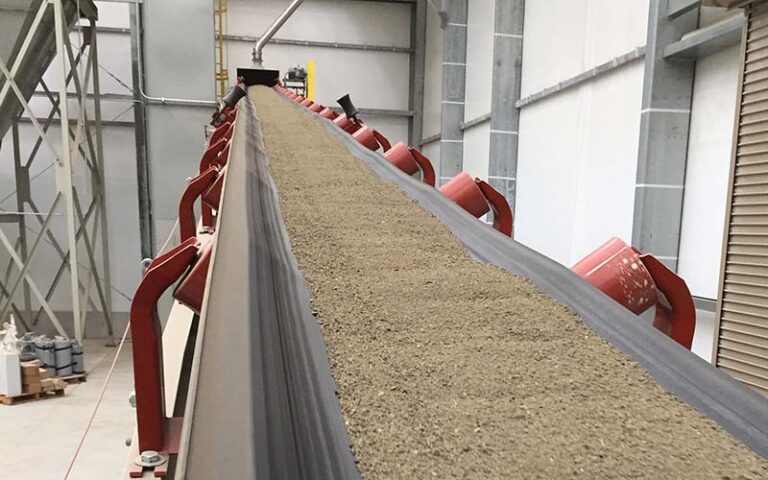
While a rotary dryer project usually begins with a target throughput, what actually determines the dryer’s design is the material. Two feedstocks dried to the same outlet moisture at the same production rate demand entirely different systems, with each material dictating how heat is transferred, how fast water can leave, and what the exhaust gas will require.
Optimal performance depends on finding the right balance between the material characteristics and how the dryer is designed to work with those characteristics. The following covers the material characteristics that have the greatest influence on dryer design, and the design parameters each one impacts. For many materials, several of these apply at once, making material characterization and drying tests an integral step in designing a successful system.
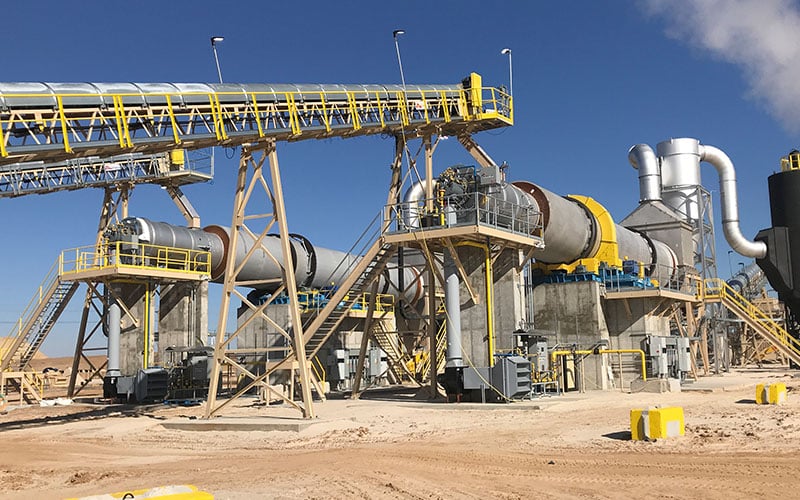
Rotary dryers at a mine site
Quick Reference Guide
| Characteristic | What it Drives | Key Design Parameters Affected |
| Moisture characteristics | Heating duty, evaporation load | Burner capacity, air flow, retention time, length/diameter ratio, inlet conditioning |
| Particle size & distribution | Entrainment risk, drying rate, and emissions handling | Gas velocity, drum diameter, flight configuration, feed conditioning, discharge breeching size, and dust collector selection |
| Bulk density | Operational load | Volumetric loading, drum sizing, drive assembly and mechanical component duty |
| Heat transfer properties | The amount of energy required to heat the material and how quickly it takes heat up | Burner capacity, time and temperature profile, dryer sizing, air flow configuration |
| Thermal sensitivity | Maximum allowable heat exposure | Inlet and outlet temperature limits, heat source selection, flight design, burner turndown and controls |
| Stickiness & tackiness | Equipment wear, flow through drum | Inlet design, materials of construction, flight geometry, and knocker use |
| Fragility | Potential for attrition | Cascade height and frequency (via flight pattern), gas velocity, and drum diameter |
| Flowability | How material is introduced and how it moves through the drum | Feeder selection, drum slope and speed, flight design, and potential back-mixing circuit |
| Abrasiveness & corrosivity | Equipment longevity | Materials of construction, internals attachment method, and build-up control |
| Combustibility & reactivity | Fire and explosion prevention | Materials of construction, internals attachment method, and build-up control |
| Material end use | Hygiene and product purity requirements | Temperature caps, gas velocity, ignition-source control, explosion protection, direct vs. indirect configuration |
Moisture Characteristics
What it drives: Heating duty, evaporation load
Parameters it affects: Burner capacity, air flow, retention time, length/diameter ratio, inlet conditioning
Moisture is the single most influential factor in dryer design, determining the amount of work required of the system. A material’s moisture should be analyzed in several aspects:
Moisture Content: Inlet vs. Outlet Moisture
Inlet moisture is the amount the feedstock contains entering the dryer; outlet moisture is the desired moisture content of the material as it exits the dryer.
The difference between inlet (actual) and outlet (desired) moisture content establishes the evaporation load—the quantity of water the system must remove.
A Note on Maximum Allowable Inlet Moisture:
Thermal drying is the least efficient and most energy intensive method of moisture removal.1 And while rotary dryers can be used to remove a significant amount of moisture, inlet moisture content should be minimized upstream where possible, via mechanical dewatering or similar techniques.
Further, while each material responds uniquely to drying, those with a moisture content higher than 30% can be problematic, leading to sticking and buildup issues on the dryer’s interior, a pattern often seen with sludge-like or low-solids materials such as biosolids or dairy manure.
A rotary dryer can still be an option in these settings, but typically requires preconditioning to bring inlet moisture content into a more workable range for the dryer. This might include pre-drying, or the incorporation of a back mixing circuit in which dried material is mixed in with the feed.
How Material Holds its Moisture (Bound, Unbound, and Free Moisture)
Bound moisture refers to moisture held in the material’s chemical composition or physical microstructure, exhibiting a vapor pressure less than that of pure liquid. Unbound moisture, in contrast, is all remaining moisture.1 Moisture held on a particle’s surface or in large pore spaces evaporates readily, while moisture held within the structure must migrate to the surface first, and not all of it is removable. All removable moisture, whether bound or unbound, is considered free moisture—the target of all drying operations. Removing bound moisture beyond free moisture requires a chemical reaction or phase change, which must be carried out in the high-temperature environment of a rotary kiln.
The practical importance of how a material holds moisture is easy to see when looking at glass and clay. These two materials could in theory hold the same moisture content, but require different systems to reach target moisture, because glass carries its moisture on the surface, making it easier to remove, while clay carries the majority of its moisture internally, where it is harder to remove.
The Falling Rate Period and Hygroscopicity
Some materials dry quickly, until their moisture drops below a certain threshold, at which point evaporation slows significantly. During the initial “constant-rate” period, several external factors influence the rate of surface moisture evaporation—gas temperature, velocity, direction, humidity, and the amount of exposed material surface area.1 Once the critical moisture point is reached, the remaining (bound) moisture must migrate from within the particle, so external factors become less effective; during this falling rate period, drying rate is instead governed primarily by retention time and drum length.1
Sand illustrates this progression well, drying readily at first, but then becoming increasingly difficult to dry as each remaining bit of moisture is held progressively tighter within the material’s structure.
Hygroscopic materials, or those that pull moisture from the surrounding atmosphere through internal water binding sites, compound this effect. In this way, hygroscopicity determines the lowest achievable outlet moisture and how long it takes to remove the remaining free moisture.
How Moisture Characteristics Influence Rotary Dryer Design
Reaching the target moisture content is not the direct result of any one parameter, with a material’s moisture characteristics affecting several aspects of design:
- Air flow requirements and burner capacity: Established by evaporation load (inlet minus outlet moisture, times production rate).
- Surface-held moisture is addressed through gas variables: temperature, velocity, air flow configuration, as well as the amount of exposed surface area.
- Internally held moisture is addressed through volume controls: retention time, drum length, and the length/diameter ratio.
- High inlet moisture may require inlet conditioning such as back-mixing or pre-drying to be built into the process design.
- Hygroscopic materials lower the achievable outlet moisture and often shift the design toward a configuration with a lower temperature and longer retention time.
Particle Size & Particle Size Distribution (PSD)
What It drives: Entrainment risk, drying rate, and emissions handling
Parameters It affects: Gas velocity, drum diameter, flight configuration, feed conditioning, discharge breeching size, and dust collector selection
Particle size controls the dryer design in several aspects, influencing how quickly a material can heat up and release moisture, with smaller particles drying more quickly, but being more susceptible to entrainment (being swept up in the gas flow). Carbon black fines, for example, will easily become entrained in the passing air stream, while larger ore particles will not.
The distribution of particle sizes (particle size distribution or PSD) is equally important. Materials exhibiting a wide PSD force the dryer design to accommodate the full range from smallest to largest, making achieving uniformity in the end product challenging. When this occurs, preconditioning material upstream for uniformity will yield the best result.
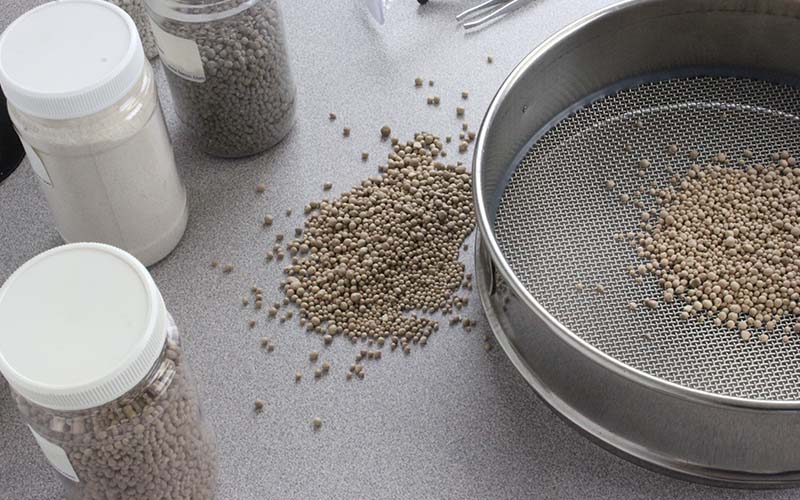
How Particle Size & Distribution Influence Dryer Design
Particle size and distribution have several ramifications on dryer design:
- Gas velocity must be capped below the entrainment velocity of the finest fraction; the finer the material, the lower the allowable velocity.
- A limited velocity at a required air volume can push drum diameter up.
- Flight design is selected for how the full size range responds to being picked up and showered.
- The level of fines entrainment drives the off-gas and dust collection system, with the cyclone, baghouse, or wet scrubber sized according to the expected dust loading.
- The discharge breeching, sometimes also referred to as a knockout chamber, may be enlarged in some settings to help reduce entrainment.
Bulk Density
What It drives: Operational load
Parameters It affects: Volumetric loading, drum sizing, drive assembly and mechanical component duty
A material’s bulk density, the weight of a material at a given volume, affects dryer design in two ways: the load the drum will carry and the allowable volumetric fill.
A material with a high bulk density, such as aggregates, places a significant operational load on the dryer and the amount of energy that will be required per cubic foot to rotate the drum with a live load at the desired speed. This requires heavy-duty mechanical components throughout; girth and pinion gears, motor, reducer, drive shafts, bearings, etc. will all need to be sized for higher static and dynamic loads and greater torque.
In contrast, a lower-density material like fly ash requires lighter-duty components. Low-density materials come with a trade-off, however: they can be easier to entrain, constraining gas velocity.
Engineers must design for the maximum allowable volumetric load while minimizing drum size and the potential for entrainment.
Heat Transfer Properties (Specific Heat & Thermal Conductivity)
What it drives: The amount of energy required to heat the material and how quickly it takes heat up.
Parameters it affects: Burner capacity, time and temperature profile, dryer sizing, air flow configuration.
The way in which a material transfers heat must also be taken into account during the dryer sizing and design process. This is primarily measured in two properties.
Specific Heat
Specific heat is defined as the amount of energy required to raise one gram of material by one temperature degree—ultimately how resistant a material is to heating. Water, for example, has a very high specific heat, meaning that it requires a significant amount of energy to raise its temperature. Metals, however, have a low specific heat, meaning it takes much less energy to raise their temperature.
Thermal Conductivity (Conductors vs. Insulators)
Thermal conductivity refers to how readily heat travels through a material. Metals, particularly those that are non-ferrous, readily conduct heat, while materials such as wood conduct poorly, acting instead as insulators.
These two qualities—specific heat and thermal conductivity—shape the design differently: specific heat primarily determines the amount of energy needed to heat the material, while thermal conductivity determines how quickly the material will heat up, ultimately influencing the amount of retention time and temperature required for the bed to reach target moisture.
How Heat Transfer Properties Influence Dryer Design
Heat transfer properties influence several aspects of dryer design. Most notably:
- Burner capacity: The burner must deliver the specified energy (BTU/hr) to reach target temperatures, scaled to the material’s specific heat and evaporation load.
- Time–temperature profile: Conductive, low-specific-heat materials warm readily and can be handled with shorter exposure; insulating materials need more time, more temperature, or both, and this shapes dryer sizing and the temperature profile.
- Air flow configuration interacts with heat transfer behavior—see Co-current vs. Counter-Current Drying. Sand that dries readily until the final points of moisture, where a counter-current configuration puts the hottest gases at the discharge end, drawing out the remaining, most difficult-to-remove moisture.
Thermal Sensitivity
What it drives: Maximum allowable heat exposure
Parameters it affects: Inlet and outlet temperature limits, heat source selection, flight design, burner turndown and controls.
Some materials are sensitive to heat, experiencing degradation, oxidation, scorching, or volatilization if overheated. This caps the maximum allowable product temperature, and often the gas temperature. Reaching target moisture without exceeding that ceiling requires a careful balance of temperature with time.
How Thermal Sensitivity Influences Dryer Design
- Inlet and outlet temperature limits: The maximum product temperature caps the gas temperature the material can safely see.
- Heat source selection: Temperature limits are one of the main reasons a design moves from direct-fired to indirect-fired heat—keeping combustion gases and product apart—or switches to a lower-temperature, longer-residence configuration and potentially the incorporation of a combustion chamber to prevent material from coming into contact with the burner flame.
- Flight design: How much material is repeatedly lifted into the hottest part of the gas stream can be adjusted to manage exposure for temperature-sensitive loads.
- Burner turndown and controls: The ability to run a soft, regulated temperature profile rather than a hot front end matters more here than almost anywhere else.
For moisture- and temperature-sensitive pairs like hygroscopic fertilizers, these limits combine with moisture behavior to require a low-temperature, long-retention design.
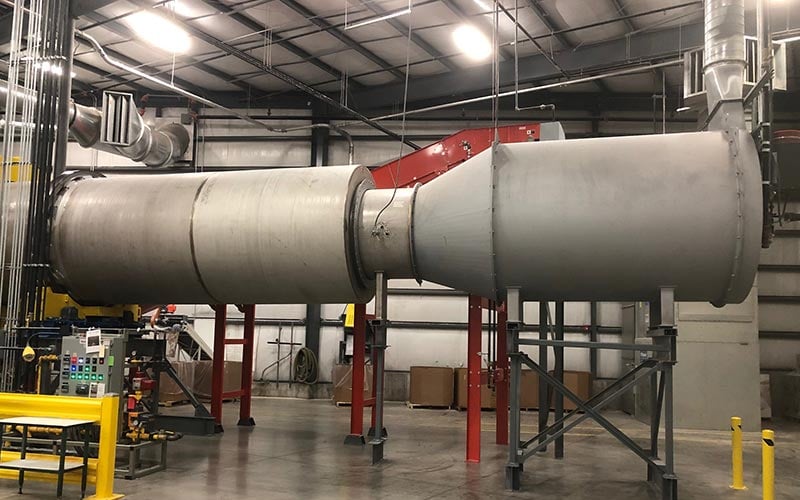
Combustion chamber on a rotary dryer
Stickiness & Tackiness
What it drives: Equipment wear, flow through drum
Parameters it affects: Inlet design, materials of construction, flight geometry, and knocker use
Materials that are sticky or sludge-like can be problematic for rotary dryers, causing sticking and buildup issues. Some materials, if allowed to continually stick and dry at the inlet, can pose a fire hazard if not carefully managed.
How Sticky, Tacky Materials Influence Dryer Design
There are several ways to address sticky materials through proven design modifications.
- A bald section, in some cases with straight flights, at the inlet lets the material begin drying before it encounters single- and double-bend flights, shrinking the window for sticking.
- Knockers, which dislodge interior build-up by knocking the rotating drum’s exterior, actively minimize buildup for materials with a persistent tendency to stick, such as potash and gypsum.
- Feeders, inlet design, and discharge points are engineered for clean release rather than assuming a free-flowing material.
- The addition of a back-mixing circuit moves the material past its sticky phase before it reaches the drum.
Fragility
What it Drives: Potential for attrition
Parameters it Affects: Cascade height and frequency (via flight pattern), gas velocity, and drum diameter
Direct rotary dryers use direct contact between the material and the products of combustion to dry the material. To increase this contact and improve heat transfer, flights lift the material and drop it in a cascading motion through the gas stream in the drum’s cross section. This dropping action can be too aggressive for materials that are prone to breaking down.
How Fragility Influences Dryer Design
- A bald section at the inlet gives fragile material a chance to harden before being gradually introduced to the cascading action, averting most undesirable breakdown.
- Flight pattern: Where the material is inherently delicate, flight pattern can be adjusted to reduce drop height and frequency.
- Material durability, particle size, and weight together set the maximum air velocity that won’t degrade the material—a restriction in addition to the entrainment cap from PSD—which in turn sizes the system fan and influences drum diameter.
Flowability
What it drives: How material is introduced and how it moves through the drum
Parameters it affects: Feeder selection, drum slope and speed, flight design, and potential back-mixing circuit
How flowable a material is is often a result of its moisture content, but it also depends on particle shape and texture. Smooth spherical fertilizer granules, for example, have a low angle of repose, making them inherently more flowable. In contrast, fibrous, coarse material, such as digested dairy manure, is significantly less flowable, because particles can interlock and catch on each other. Powdered fines may clump together, creating inconsistent flowability.
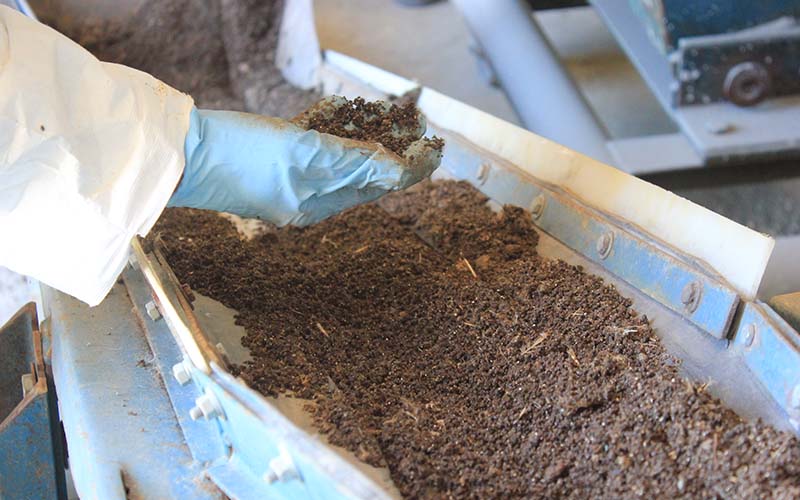
How Flowability Influences Dryer Design
While rotary dryers handle free-flowing materials best, they can accommodate less flowable materials with some design modifications.
- Feeder selection matched according to the material’s flow character.
- Steeper drum slope or higher drum speed to encourage movement in a sluggish bed.
- Flight geometry adjusted for retention or material fed with a back-mixing circuit where flowability is moisture-driven.
Abrasiveness & Corrosivity
What it drives: Equipment longevity
Parameters it affects: Materials of construction, internals attachment method, and build-up control
Materials that are abrasive or corrosive (or both) can also affect the design of a rotary dryer, requiring provisions to protect against premature wear.
How Abrasiveness & Corrosivity Influence Dryer Design
Abrasive or corrosive materials will require special design considerations in order to avoid premature equipment failure or excessive damage to the unit.
- Materials of construction are the primary defense: the shell and internals must be built from grades resistant to the specific abrasion or corrosion expected. For corrosion in particular, matching the metallurgy to the material’s chemistry, and to any corrosive species the drying process itself generates in the exhaust, is essential to unit longevity.
- Minimize buildup: Because corrosion concentrates in cracks and crevices, design choices that discourage build-up support corrosion control.
- Internal attachment: In abrasive service, lifters can be bolted to the shell rather than welded, allowing inexpensive replacement as they wear.
Combustibility & Reactivity
What it Drives: Fire and explosion prevention
Parameters it Affects: Temperature caps, gas velocity, ignition-source control, explosion protection, direct vs. indirect configuration.
The potential for material combustion guides the design in two ways. First, through minimizing dust hazards, as fine, dry, combustible solids dispersed in warm moving gas create the conditions necessary for dust deflagration. Inlet temperatures must be capped, gas velocity constrained, and ignition sources (burner management, spark detection/suppression, tramp metal removal) engineered out, with explosion protection (venting or suppression) designed to applicable National Fire Protection Association (NFPA) combustible dust standards.
Second, through material protection: some materials are combustible only under certain conditions, such as in the presence of oxygen, requiring a tightly controlled processing atmosphere.
Both problems converge at the same solution: the indirect dryer configuration. Because indirect dryers are externally heated, material does not come into contact with combustion gases and the processing environment can be precisely controlled.
Material End Use
What it Drives: Hygiene and product purity requirements
Parameters it Affects: Direct or indirect configuration
Rotary dryer design can also be influenced by the intended end use of a product. Consumer-facing products that must be absolutely sterile, or materials sterilized through heat, call for configurations and construction that keep the product uncontaminated: indirect or tightly sealed heating, stainless construction, and in cases where the material cannot be allowed to cake, a completely polished interior with no imperfections where material could catch and pile up.
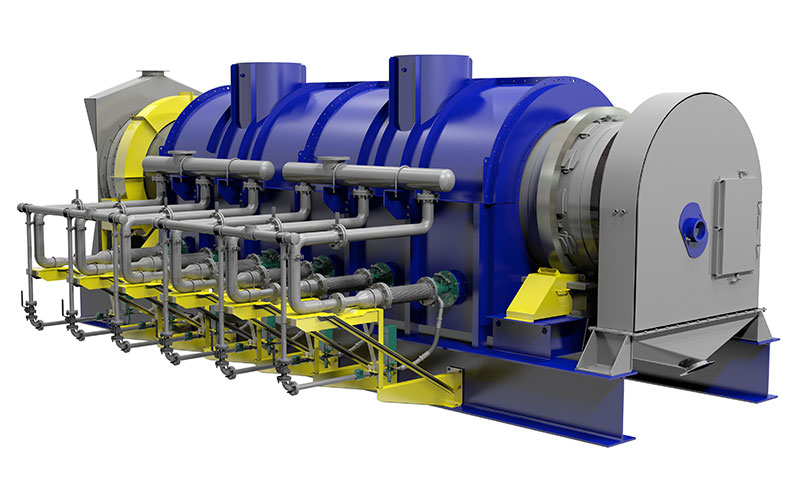
3D Model of a FEECO Indirect Dryer
Developing a Rotary Dryer Design Through Testing
How the myriad of potential characteristic combinations will behave in a rotary dryer is not something that can be fully predicted with a single data set.
Developing an efficient drying process that yields the desired product quality is not always a straightforward endeavor. This is particularly true of materials presenting unique challenges, or when developing a process around a novel material.
Testing is often conducted to gather critical data points and assess how the specific material responds to the drying process. In addition to gathering data for scale-up, testing also de-risks the path to commercialization and identifies any preconditioning requirements.
The FEECO Innovation Center offers a pilot-scale rotary dryer for continuous testing of a wide range of materials. Through testing, experts in the Innovation Center identify key process parameters, work out critical process variables, and develop an efficient approach to drying the representative sample. Gathered data includes:
- Retention time
- Dryer temperature
- Drum speed and slope
- Air volume
- Feed rate
- Feedstock characteristics
- Gas sampling & analysis
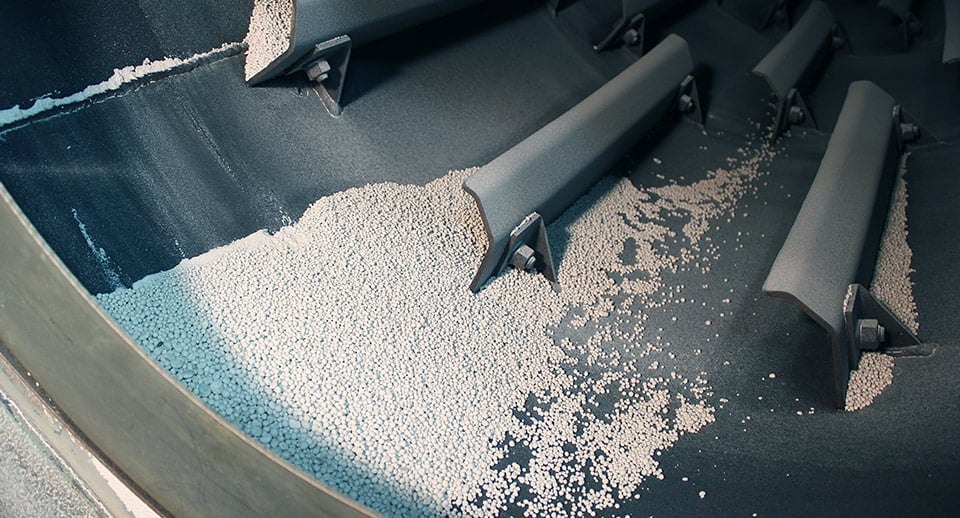
Interior view of granules in a rotary dryer during testing in the FEECO Innovation Center
The Innovation Center is also home to a unique flight simulator which allows various flight designs to be trialed. Flights, or lifters, are a vital component in promoting maximum heat transfer in a rotary dryer.
Conclusion
A rotary dryer that performs well and remains reliable for a long service life is the result of designing the dryer around the material and its unique qualities. Moisture characteristics, particle size, heat transfer properties, and the like shape every aspect from feeding to flights and drum speed. Because these characteristics interact and no design parameter operates in isolation, thorough material analysis backed by real-world testing data is the most reliable path to a successful commercial drying operation.

