


The benefits of a preventive maintenance program are well documented – reduced downtime, lower maintenance costs, improved safety, and longer equipment service life, among others. And yet, many industrial facilities continue to rely on reactive maintenance strategies for their capital equipment, exposing them to unnecessary risks and elevated costs.
As pressure to maximize efficiency and equipment longevity continues to mount, more plant managers and maintenance personnel are looking to move away from reactive maintenance, but the path to a preventive maintenance strategy is not always clear.
The FEECO Customer Service Team has been a trusted partner in helping facilities transition their maintenance practices to a more effective approach. Here’s a look at what the process entails.
What is Preventive Maintenance?
Preventive maintenance is the opposite of a reactive or run-to-failure (RTF) approach (in which personnel respond to issues only after they’ve occurred). Instead, a preventive maintenance program focuses on avoiding failures and unplanned downtime by preventing issues before they occur.
How a preventive maintenance plan looks can differ from one plant to the next, with many plants incorporating a combination of principles from different maintenance approaches. Whatever it looks like, the goal is the same: minimize unplanned downtime and unnecessary maintenance costs.
Preventive maintenance is often a step in the larger process toward reliability-centered maintenance, or RCM, a more holistic approach that aligns maintenance with business goals based on data.
How to Move Away From A Reactive Maintenance Strategy
Start With an Equipment Audit (Inspection)
The first step in taking a preventive approach to maintenance is to identify and document the current condition of equipment; a preventive program cannot be built on assumptions—it must start with accurate data on equipment health.
FEECO recommends starting by having the OEM or other qualified service provider conduct a mechanical audit of the plant’s capital assets. This accomplishes two key objectives:
- Establishes benchmark data
- Identifies issues to be prioritized and planned
Prioritize Identified Issues
An equipment audit may uncover a range of mechanical concerns, from minor wear to critical defects. For plant managers and maintenance personnel, the challenge often lies in determining the order in which to address these issues.
Personnel must prioritize repairs based on plant safety first, followed by issues with a high risk potential, such as catastrophic failure. Once these critical repairs have been made, personnel can move on to making improvements geared toward production efficiency and finally, mid- to long-term changes in production.
Coordinating Repairs for Lasting Results
Because some repairs often have implications on other issues, plant personnel should also collaborate with the OEM or other qualified service provider to establish the most effective, least costly path to resolution. Consider the following example:
A rotary dryer audit reveals that guarding is missing around the gear and pinion drive assembly. The audit further reveals that the dryer has fallen out of alignment, tires and trunnions are exhibiting wear patterns, and worn breeching seals are affecting dryer performance, resulting in inconsistent product.
The lack of guarding exposes operators and maintenance personnel to a dangerous pinch point, making this the obvious issue to address first. It may be tempting to follow this with replacement of the breeching seals, as these are actively incurring costs. However, doing so without first addressing worn load-bearing surfaces and misalignment could make seal replacement problematic and ineffective.
Additionally, since resurfacing via grinding changes base conditions, a post-grinding realignment is recommended. As a result, FEECO recommends realigning the drum after reconditioning tires and trunnions, to prevent the problem from reoccurring.
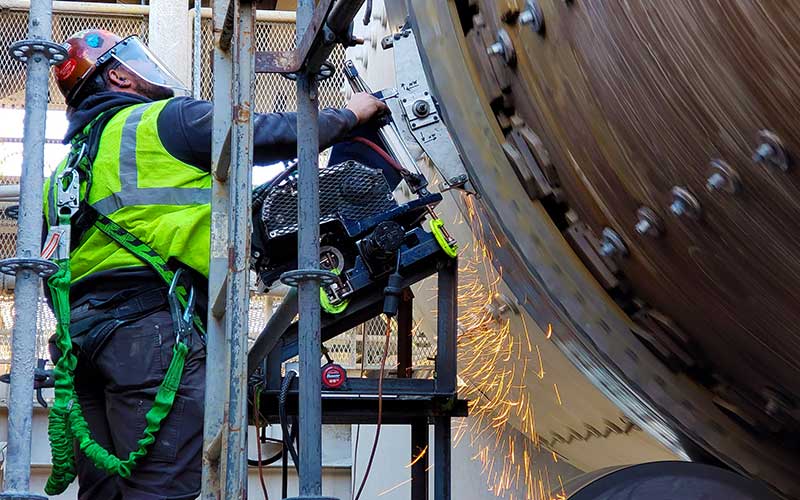
Tire grinding on a rotary drum in progress
In this case, FEECO would recommend the issues be resolved in the following order to avoid unnecessary rework and subsequent issues:
- Installation of new guarding
- Tire and trunnion grinding
- Rotary drum realignment
- Seal repair or replacement
Carrying out all other repairs prior to addressing the seal issues ensures the rotary dryer is optimally positioned for seal installation and long-term effectiveness. This workflow, commonly seen in the field, exemplifies the essential role that an experienced OEM or service provider plays in addressing issues strategically for the most effective outcome.
Establish Maintenance Milestones
Once the equipment’s operating condition is known and any immediate repairs have been addressed or planned, maintenance personnel can begin establishing forward-thinking maintenance procedures.
This can be achieved by working with the OEM to develop service milestones based on the unique operating conditions of the plant and the OEM’s experience.
Routine Maintenance
Some procedures, such as oil changes and lubrication, will follow a set schedule, with little influence from outside conditions. This routine maintenance may be based on time or throughput intervals. In some settings, it may be easier for plants to base maintenance around production cycles (opportunity-based maintenance). This type of maintenance typically includes:
- Bearing lubrication
- Replacement of graphite block lubricators
- Lubrication of chain and sprocket or gear and pinion drive assembly
- Gear box oil changes
Condition-Based Maintenance (CBM)
Other repairs, such as tire reshimming or remounting are dependent on how equipment wears in the field. This type of maintenance may or may not follow a loose schedule, requiring operators and maintenance personnel to closely monitor any changes in their condition.
- Tire reshimming (typically required every 3-7 years)
- Tire remounting (typically required every 7-10 years or after two reshims)
- Bearing replacement
- Thrust roller adjustment or replacement.
- Trunnion replacement
- Flight (material lifter) replacement
- Seal repair or replacement
- Shell repairs
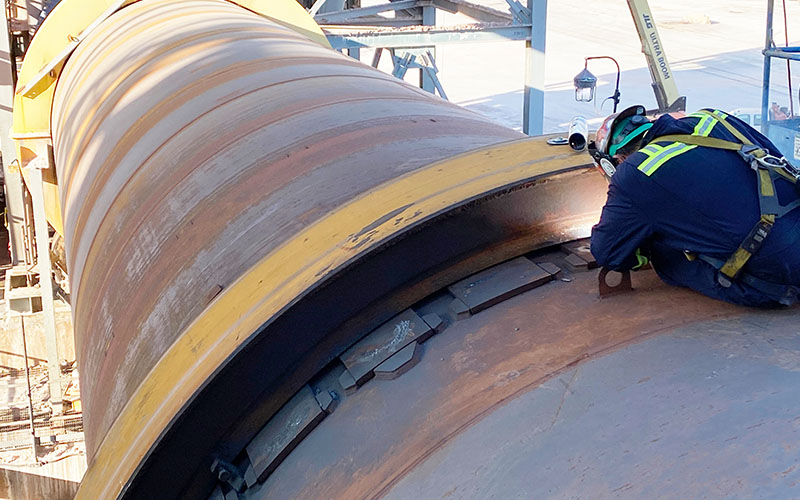
Tire (Riding ring) mounting system repair in progress
Maintenance planning may differ depending on the plant’s condition monitoring capabilities. Plants equipped with equipment sensors and advanced control systems may be able to rely on programmed key performance indicators (KPIs) to assist in monitoring and scheduling maintenance, while others will rely solely on visual and auditory observations.
Develop Inspection Protocols
Maintenance planning and inspections go hand-in-hand, with a strategic, well-executed inspection schedule being the foundation of a successful preventive maintenance program.
Equipment inspections are critical to recognizing subtle changes in mechanical components, helping to identify issues at their onset, before they can escalate into larger problems.
Based on maintenance milestones and routine inspections, managers can develop tailored inspection schedules for daily, weekly, monthly, and ongoing procedures.
Inspection schedule check sheets should be developed for each piece of capital equipment and include not only all items to be inspected (and potentially a more detailed indication of their condition), but also a signoff for who conducted the inspection and on what date. Completed inspection forms should be catalogued for future reference and record keeping.
Opt for an Annual Inspection
In addition to the plant’s in-house inspection schedule, FEECO recommends that all equipment also undergo an annual inspection by the OEM or other qualified service provider for a more in-depth evaluation of mechanical condition and to uncover more subtle signs of wear or the start of any potential issues.
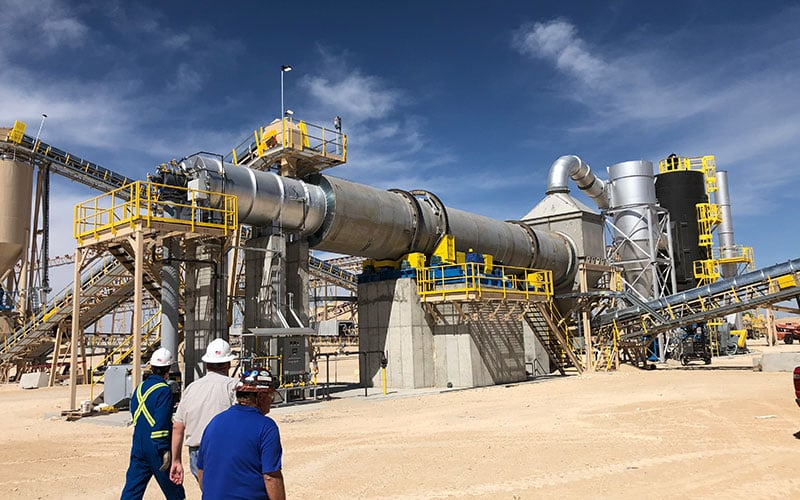
A FEECO Customer Service Engineer conducts an annual rotary dryer inspection
Build a Parts Inventory
Inspections alone are not enough to prevent unnecessary downtime if the right parts aren’t on hand; a strategic spare parts inventory, though often overlooked, is another foundational aspect of a successful preventive maintenance program. A strategic parts inventory can also help to minimize the plant’s exposure to external market factors that cause volatility in lead times and prices.
An effective spare parts inventory should balance cost with risk, considering factors such as level of risk in the event of a failure, component/assembly lead times, anticipated maintenance schedules, and historical requirements.
FEECO recommends working with the OEM to identify wear-critical parts or those subject to volatility to keep on hand. The manufacturer can also recommend parts that are less subject to long lead times, allowing them to be ordered on an as-needed basis.
How to Get the Most Out of A Preventive Maintenance Program
Train Operators & Maintenance Personnel
Operators and maintenance personnel cannot adequately monitor equipment condition and performance if they are not properly trained. Take advantage of OEM training programs to ensure plant personnel can safely and properly inspect, operate, and maintain equipment.
Knowing where potential for problems exists, what is “normal” for the unit, and the ability to recognize visual or auditory abnormalities or subtle changes in product output often means the difference between a potentially quick fix and unplanned downtime dedicated to troubleshooting and resolving issues.
Schedule Around Planned Shutdowns
Where possible, schedule more in-depth inspections and maintenance procedures around planned shutdowns to get the most out of required downtime. Carrying out work during this time avoids the need for additional shutdowns.
Track KPIs and Keep Detailed Records
Track maintenance key performance indicators (KPIs) to follow progress and reveal trends. Common KPIs tracked on capital equipment include overall equipment effectiveness (OEE), mean time between failures (MTBF), mean time to repair (MTTR), and planned vs. unplanned downtime.
Knowing and tracking such data is a powerful way to optimize a preventive maintenance program for maximum efficiency.
Avoid Common Pitfalls
Two common mistakes can hinder the success of a preventive maintenance program:
Overlooking Actual Plant Conditions
Over-reliance on time-based schedules may incur wasted cost if intervals do not align with actual plant operating conditions. Allow flexibility for adjustments where needed based on what operators and maintenance personnel are seeing in the field.
Not Giving the Program Time
The initial transition to preventive maintenance can seem slow and problematic as backlogged issues are identified and resolved. Allow the program to stabilize before expecting reductions in maintenance costs and downtime.
Conclusion
Transitioning from a reactive to a preventive maintenance strategy requires effort, but the payoff in reduced downtime, lower costs, and improved safety is undeniable. By starting with a thorough equipment audit, prioritizing issues strategically, building inspection and inventory systems, and investing in training, facilities can set the foundation for long-term reliability and performance. With OEM support, the process becomes not only more manageable, but also more effective, helping plants achieve their production and safety goals while protecting the life of their capital equipment.
FEECO has been a trusted partner in maintaining production equipment and systems such as rotary drums, bucket elevators, and fertilizer plants since 1951. With over 75 years of experience and a comprehensive parts and service program that caters to any equipment brand, we can help you make a smooth transition from reactive to preventive maintenance and beyond. For more information, contact us today!

