

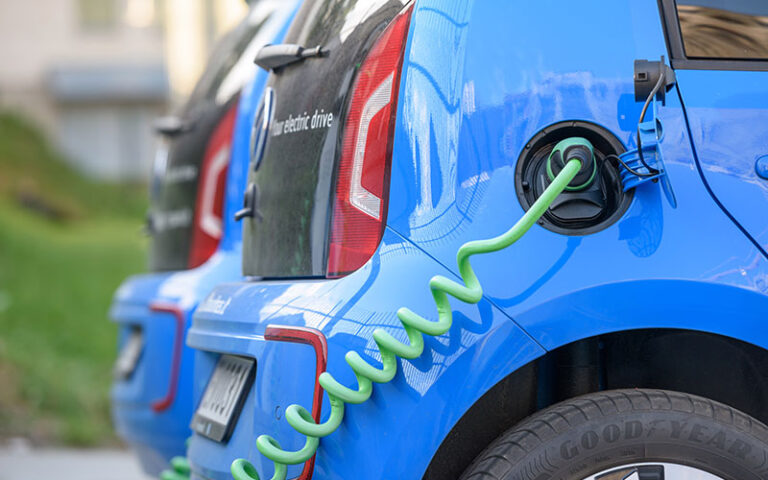
As the mining industry continues to develop critical mineral resources, a new lithium extraction technique could be key to feeding the insatiable demand for the lightweight metal, while minimizing environmental impact.
Direct lithium extraction (DLE), though still limited in commercial use, is emerging as a key technology for securing domestic lithium supply in the United States.
How is the Lithium Mining Landscape Changing?
Historically lithium mining has taken one of two forms: extraction from salt brines or from hard-rock ores, most commonly spodumene. Each method is effective in the right setting, but neither is perfect.
Brine mining is inefficient, requiring significant amounts of brine to obtain a small amount of lithium. This technique, which utilizes a series of evaporation ponds to concentrate lithium, also requires substantial swaths of land, earning the opposition of environmentalists and requiring lengthy evaporation times. Reaching production with brine operations can also take up to 15 years.[1]
Hard-rock mining is more efficient than brine mining, but still leaves much to be desired. As with other mining operations, hard-rock mining is disruptive to the land and presents potential environmental challenges. Hard-rock mines are also subject to the cumbersome and lengthy development and permitting process, which can take 10-17 years from discovery to first ton.[1]
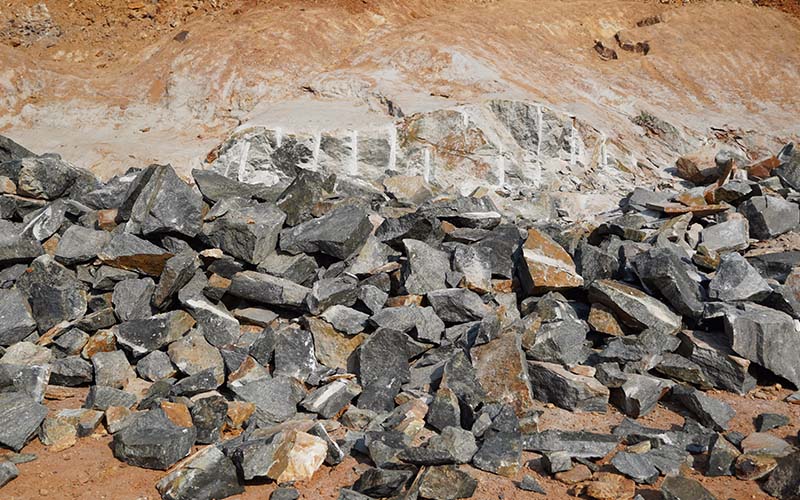
Hard-rock lithium ore
Both techniques have served the industry well and remain important in meeting lithium demand moving forward, but with demand expected to surge to unprecedented heights, the world requires a more efficient and faster solution, and DLE could be the answer.
What is Direct Lithium Extraction (DLE)?
Like brine mining, direct lithium extraction, or DLE, also extracts lithium from brines, but in a much more efficient way and from different types of brine.
Instead of pumping brines into surface ponds for slow evaporation, DLE uses one or more technologies (solvent extraction, ion exchange, adsorption, etc.) tailored to the brine’s unique chemistry to selectively extract lithium from brine, leaving most other salts behind.[2]
While the extraction step in DLE relies on advanced chemistry, bringing lithium to market still depends on proven solids and thermal processing equipment. Once lithium is selectively removed from brine, it must be crystallized and dried into a stable, transportable product such as lithium carbonate or lithium hydroxide. This is where industrial systems such as rotary dryers and material handling equipment play a critical role in turning lithium-rich solutions into saleable battery-grade products.
What are the Benefits of DLE?
DLE offers several potential benefits compared to traditional lithium mining:
Significantly Faster Lithium Recovery
Unlike traditional brine mining, which takes up to 18 months to recover lithium via evaporation, DLE cuts the extraction time down to two weeks.[3]
Opportunities to Use Brownfield Brines and Previously Non-Economic Sources
Work around DLE has also been focused on tapping into unconventional brine sources, of which the United States hosts several that could provide a critical domestic supply.
While traditional brine mining utilizes continental brines, such as those from salt lakes, DLE opens doors to novel lithium sources. Most notably, this includes brines with a lithium concentration previously considered too low for economic extraction – in many cases, brownfield brines.[4]
Brownfield brines from geothermal energy production, as well as “produced water” left over from the oil and gas industry, provide a readily accessible resource that could reduce costs associated with DLE through existing infrastructure. [4]
Work is also underway to employ DLE to seawater, which hosts a significant amount of lithium, but presents many challenges to recovery.
Lower Environmental Impact
DLE is significantly less environmentally disruptive than hard-rock or traditional brine mining, utilizing less water and having a much smaller footprint. Research estimates that land use is reduced by a factor of around 10,000 compared to operations with evaporation ponds. Additionally, extraction from geothermal brines can be less carbon-intensive when powered by on-site geothermal energy. [4]
Potential to Improve Recovery at Traditional Brine Operations
The advancements made around DLE could also hold potential to improve existing and traditional brine recovery operations.
Current Work in DLE
As DLE technologies move from laboratory concepts to commercial production, the ability to validate and scale downstream processing steps becomes critical. At the FEECO Innovation Center, lithium producers and technology developers can test drying, agglomeration, and material handling processes using pilot-scale equipment designed to replicate full-scale performance.
This includes evaluating rotary dryers and fluid bed dryers for drying lithium carbonate, lithium hydroxide, and intermediate lithium salts produced by DLE, as well as developing and conditioning sorbents and catalyst materials used within DLE systems.
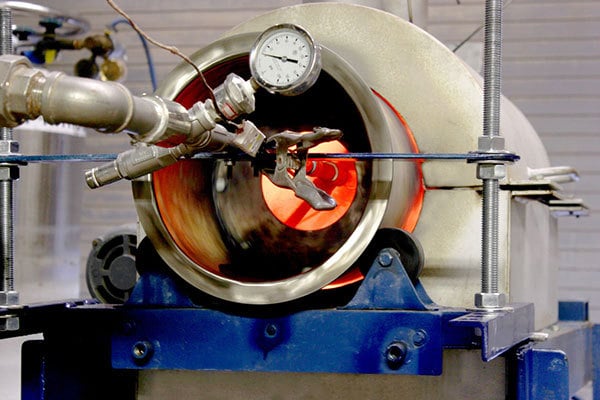
For projects involving chemical reactions—such as roasting, phase conversion, or thermal regeneration of sorbents—FEECO also offers batch- and pilot-scale rotary kilns, allowing lithium refiners to validate reaction kinetics, residence time, and temperature profiles before committing to commercial equipment.
Thus, while DLE is far from just a theoretical approach, it is still largely in development, with many challenges to overcome.
Commercial use of DLE is currently limited, but constantly advancing. Data firm Wood Mackenzie estimates that by 2028, DLE will account for an annual output of 301 kt LCE (lithium carbonate equivalent) – up from 83.7 kt in just 2023.[5]
And while DLE production is currently concentrated in Argentina and Chile, the United States is on its way to commercializing the technology as well. Commercial use of DLE is developing around the Smackover formation – a lithium-rich brine that sprawls over southwest Arkansas and east Texas. Standard Lithium is developing the project in collaboration with Equinor in what is likely to be North America’s first commercial DLE operation.
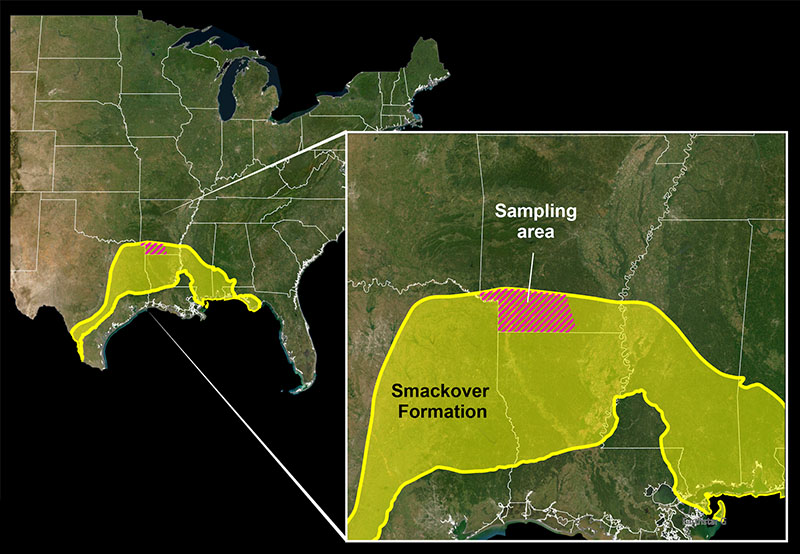
Smackover Formation | Source: USGS
Significant opportunity also lies in the Salton Sea Known Geothermal Resource Area (KGRA), as well as other brines located in California, Nevada, and Utah. [4]
Conclusion: Where DLE Meets Real-World Processing
Direct lithium extraction represents one of the most promising shifts the lithium industry has seen in decades, opening the door to faster production, lower environmental impact, and access to brine resources that were once considered uneconomic. As DLE technologies mature, they are poised to play a major role in securing the lithium supplies needed to support electric vehicles, energy storage, and the broader energy transition.
However, extracting lithium from brine is only one part of the equation. Once lithium is selectively removed, it must still be transformed into a stable, high-purity solid product that can move through global supply chains. This downstream processing—crystallization, drying, and material handling—is where proven industrial equipment becomes essential.
With more than 75 years of experience designing custom thermal processing, agglomeration, and bulk material handling systems, FEECO supports the final steps that turn lithium-rich solutions into battery-grade products. Through testing in our Innovation Center and full-scale equipment engineered for each project’s unique chemistry and production goals, producers can de-risk scale-up and ensure their DLE flowsheet delivers commercial-ready lithium products.
As DLE continues to move from pilot plants to full-scale commercial operations, the ability to reliably process and handle lithium materials will be just as important as the extraction technology itself. To learn how FEECO can assist your lithium processing operation, contact us today!
SOURCES:
- LithiumHarvest. The Lithium Mining Market. LithiumHarvest, Oct. 30, 2025. https://lithiumharvest.com/knowledge/lithium/the-lithium-mining-market/
- International Lithium Association. Direct Lithium Extraction (DLE): An Introduction. June 2024. https://lithium.org/wp-content/uploads/2024/06/Direct-Lithium-Extraction-DLE-An-introduction-ILiA-June-2024-v.1-English-web.pdf
- BloombergNEF. Direct Lithium Extraction on the Cusp of Commercialization. May 21, 2024. https://about.bnef.com/insights/commodities/direct-lithium-extraction-on-the-cusp-of-commercialization/
- U.S. Department of Energy, Office of Scientific and Technical Information. Lithium Production from North American Brines. U.S. DOE, 2025. https://www.osti.gov/servlets/purl/1891626
- Wood Mackenzie. Direct Lithium Extraction: Is the Hype Justified by the Reality? Oct. 1, 2024. https://www.woodmac.com/news/opinion/direct-lithium-extraction-is-the-hype-justified-by-the-reality/
