


Many of the rotary dryers in service today, regardless of industry, were installed ten, twenty, and even several decades ago, during which time energy prices have gone up, feed characteristics have changed, and dryers have experienced wear and tear. In many cases this has led to a quiet accumulation of inefficiencies. Fortunately, most of these don’t require system replacement; meaningful efficiency gains can be captured through strategic upgrades.
With over 75 years of experience designing and maintaining rotary dryers—one of the most common industrial dryer types on the market—we’re covering the most effective ways to improve thermal efficiency and eliminate energy inefficiencies in existing drying operations.
Key Takeaways:
- Industrial drying is the most costly energy input for most operations, making it a critical target for optimization.
- Replacement is not the only option for plant managers looking to improve on efficiency; efficiency can often be gained back through targeted maintenance procedures, such as seal upkeep, and the implementation of best practices in operation, such as limiting the amount of cycling.
- A process audit by the OEM or other qualified service provider can reveal hidden inefficiencies.
- Several upgrades and retrofits, such as flight design optimization or the addition of a combustion chamber can also improve efficiency.
The Cost of Drying
Drying accounts for roughly 10-15% of industrial energy consumption in developed countries.1
From mineral processing to chemical production, paper manufacturing, and waste management, drying is a pivotal aspect of nearly every industrial process. A non-negotiable step, drying prepares materials for downstream equipment, lowers shipping costs, and ensures product quality across a host of industries.
As one of the most energy-intensive processes in any industrial setting, drying represents a substantial cost to processors, often accounting for the primary energy load on a process. In the paper sector, drying accounts for 60-80% of total process energy consumption.2
This has producers constantly on the hunt for energy savings. And as energy prices rise and emissions standards tighten, the pressure to minimize inefficiencies only continues to rise.
Consider a plant evaporating 20,000 lb/hr of water, running 8,400 hours annually at a natural gas price of $6/MMBTU. At 2,000 BTU/lb, representative of a typical direct-fired dryer, the system consumes around 40 MMBTU of gas per hour, or 336,000 MMBTU annually, equating to around $2 million.
| Energy per pound water evaporated | $4/MMBTU | $6/MMBTU | $8/MMBTU | $10/MMBTU |
| 1,000 BTU/lb – theoretical minimum | $4 | $6 | $8 | $10 |
| 1,500 BTU/lb – well-optimized system | $6 | $9 | $12 | $15 |
| 2,000 BTU/lb – typical direct-fired | $8 | $12 | $16 | $20 |
| 2,500 BTU/lb – degraded or inefficient | $10 | $15 | $20 | $25 |
Note: Figures are illustrative; actual costs depend on site fuel analysis, material characteristics, and operating hours.
Each 100 BTU/lb improvement saves 2 MMBTU/hr—16,800 MMBTU over a year—worth approximately $100,000 annually at $6/MMBTU. For reference, the theoretical minimum for evaporating water is roughly 970–1,000 BTU/lb, meaning the distance between a degraded system (2,500 BTU/lb) and a well-optimized one (1,500 BTU/lb) spans about $1 million per year under these conditions.
How to Improve Rotary Dryer Efficiency
While most plant managers assume dryer replacement is their only option for meaningful gains, the most cost-effective wins often come from targeted maintenance and operational practices, as well as strategic upgrades. The following table provides a summary of the most common issues and upgrade options where energy savings can be gained.
| Maintenance Improvements | Operational Best Practices | Retrofits & Upgrades |
| Resolve seal degradation | Avoid over-firing | Optimize flight configuration |
| Address burner & fuel train wear and calibration | Minimize cycling | Retrofit a combustion chamber |
| Maintain sensors and instrumentation | Maintain a uniform feedstock | Replace the burner |
| Repair or replace worn or missing flights | Upgrade controls | |
| Prevent buildup | Recover heat, where possible | |
| Conduct routine maintenance and process audits |
Table: Maintenance, operational, and upgrade strategies for improving rotary dryer efficiency.
Maintenance Improvements for Efficiency
Keeping all systems and components in working order is an overlooked strategy in ensuring efficiency. Particularly as production schedules change, issues arise, and external factors influence operations over time, upkeep can quickly be forgotten. The following factors play an especially critical role in maintaining energy efficiency and should be prioritized.
Resolve Seal Degradation
Significant efficiencies are often lost through dryer wear and tear, particularly when it comes to the seals.
Because rotary dryers run at a slight negative pressure, a worn seal effectively draws tramp air into the dryer, diluting and cooling the process gas. This causes the burner to fire harder in order to maintain the setpoint and increases the air load on the induced-draft fan.
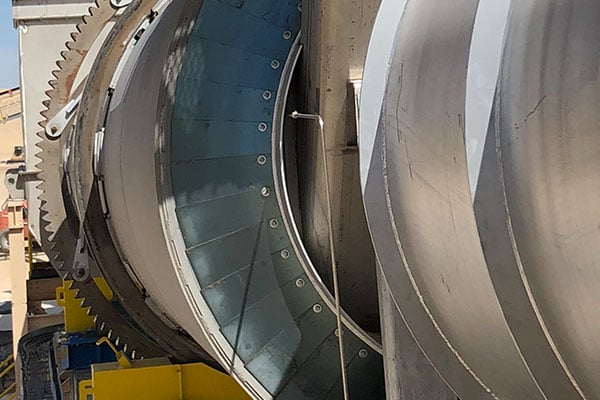
Leaf seal on rotary dryer
Worn seals also shift process temperatures, mask true exhaust conditions, and complicate burner tuning. Inspect inlet and outlet seals routinely, making repairs as needed to maintain sealing integrity and prevent tramp air ingress.
Address Burner & Fuel Train Wear and Calibration
Burner degradation often goes unnoticed until fuel consumption has crept noticeably higher. Worn or fouled components, poor atomization of liquid fuels, and most commonly, drifting air-fuel ratios, force the system to run with increased excess air in order to remain stable. Finding and calibrating the ideal air-fuel ratio based on system requirements is worth targeting considering that every point of excess air is flue gas heated to stack temperature without drying product.
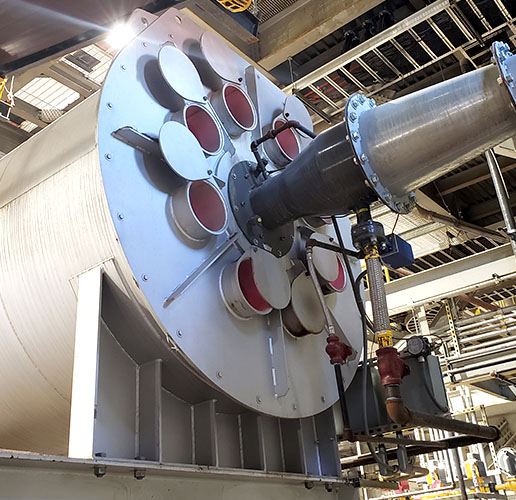
Burner feeding a combustion chamber on a rotary dryer
The U.S. Department of Energy (DOE) recognizes burner air-fuel ratio optimization as one of the least costly ways to garner energy savings in industrial process heating settings.3
Operators and maintenance personnel should regularly inspect burner components, verify fuel train performance, and trend O2 levels in the exhaust gas to keep efficiency on track.
Maintain Sensors and Instrumentation
Control systems rely on accurate data feeds to make decisions. Thus, ensuring sensors and instrumentation are in proper working order is critical to promoting an efficient operation. If a thermocouple drifts 25℉ away from calibration, for example, the burner will pursue the wrong setpoint indefinitely, without giving a warning. All instrumentation should be checked and maintained as part of an inspection schedule.
Repair or Replace Worn or Missing Flights
In a rotary dryer, heat transfer occurs primarily through convection, courtesy of lifting flights that shower material through the process gas in the drum’s cross section. This showering of material creates a “curtain” of material, which, when designed properly, maximizes surface area exposure to gas, thereby maximizing heat transfer.
Over time, flights may break away, become corroded, or abraded to a fraction of their initial design, particularly if the material of construction was not matched to the material being processed. When this occurs, the curtain of material in the drum’s cross section becomes increasingly less effective at promoting heat transfer, showering less material through the gas stream and preventing the intended cascading of material that promotes heat transfer.
Dryer flights should be regularly inspected and replaced as needed to maintain optimal heat transfer efficiency as designed.
Prevent Buildup
Buildup is another common culprit in draining energy efficiency in a rotary dryer. As with flight degradation, the presence of buildup can change flight profiles and change the path gas takes through the dryer. Buildup can also act as a heat sink, requiring the dryer to heat more material than intended and compensate for the resulting loss in heat transfer with additional fuel. Buildup can also cause a load imbalance, which puts undue strain on mechanical components.
Buildup can and should be prevented, where possible, by altering feed characteristics, modifying dryer design, or installing knockers. When shutdowns allow, the drum’s interior should be inspected for buildup and cleaned as needed.
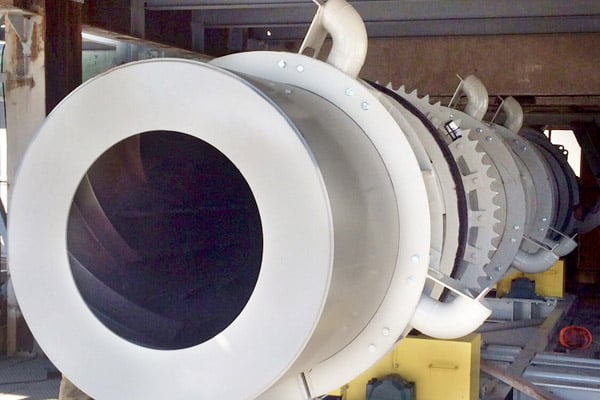
Ball-and-tube knockers on a rotary drum
Conduct Routine Maintenance & Process Audits
The mechanical condition of a rotary dryer is often overlooked as a contributing factor in energy loss. And while it’s true that a dryer’s mechanical integrity doesn’t directly affect thermal efficiency, it has a critical influence on uptime, which in turn contributes to the operating efficiency equation.
Rotary dryers and all of their components—tires, trunnions, alignment, etc.—must be properly maintained to minimize unnecessary downtime.
While many plant managers understand the importance of an annual mechanical inspection, it’s important to evaluate the system beyond its physical condition.
A process audit by the OEM or a qualified service provider can help to uncover hidden or unexplained inefficiencies through:
- Original design review (compared to current operating conditions)
- Exhaust gas analysis, excess air, and stack losses
- Inlet and outlet moisture profiles
- Particle size distribution and carryover assessment
- A heat and mass balance showing fuel in, moisture in, moisture out, and temperatures throughout
- Flight/curtain observation
- Upstream feedstock review
- Product specification review
Audits are especially valuable in detecting inefficiencies when process or feed conditions have changed.
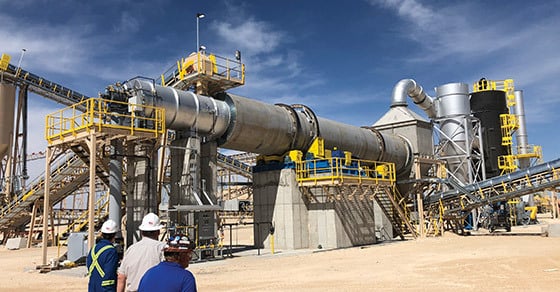
Rotary dryer process audit
Operational Best Practices for Efficiency
Operating procedures can also influence dryer efficiency. Operators should be properly trained in dryer operation, always adhering to best practices:
Avoid over-firing
Over-firing, or the application of more heat than is needed, is one of the most common sources of operational energy waste when it comes to rotary dryers. Operators increase the inlet temperature to prevent under-dried product.
While this approach does help to mitigate under-dried material coming out of the dryer, it addresses a symptom of a problem rather than the cause. It also tends to create over-dried product, which often leads to degradation. Even a slight increase in over-dried product on a dryer handling 50,000 lb/hr of dry solids may evaporate an extra 1,000 lb/hr of water—roughly 2 MMBTU/hr, or $100,000 per year at $6/MMBTU—spent on moisture the specification didn’t require.
Instead, operators should evaluate the material feed, comparing existing feed conditions to the original design. Doing so typically reveals a mismatch that can be addressed through maintaining a more uniform feedstock.
Minimize Cycling (start-ups and shutdowns)
Start-ups and shutdowns are energy intensive, often consuming the energy equivalent of 2-4 hours of normal operation. While most operations run continuously, operators and maintenance personnel should work collaboratively to minimize unnecessary downtime, with every shutdown avoided equating to energy savings.
Maintain a Uniform Feedstock
The over-firing practice underscores the importance of maintaining a uniform feedstock matched to the dryer’s design. While rotary dryers are recognized for their tolerance to changes in feedstock, more uniform material going into the dryer always translates to more uniform material coming out.
Work with vendors to ensure consistent parameters such as particle size distribution, moisture content, chemical composition, and the like. In cases where variation is inevitable, the incorporation of a pretreatment step may be justified.
Retrofits and Upgrades to Increase Efficiency
While properly maintaining all systems and components lays the foundation for maximizing efficiency, it does not account for a poorly designed system, changes in product or plant conditions, or a dryer relying on outdated technology.
When these conditions exist, plant managers need to be proactive in making targeted upgrades to close the gap on efficiency. The following upgrades typically represent the quickest wins:
Optimize Flight Configuration
Poor heat transfer resulting from inadequate flight design is one of the most common causes of excess energy use. Flights can offer the most efficient heat transfer when designed around the unique characteristics of the material to be processed. Angle of repose, moisture content, bulk density, fragility, and other material characteristics all influence how flights should be designed and positioned throughout the length of the dryer to provide the optimal curtain.
Those with one-size-fits-all flight configurations can gain meaningful results in heat transfer by optimizing their flights around the material.
The FEECO Innovation Center offers flight simulator testing for those interested in exploring alternative designs.
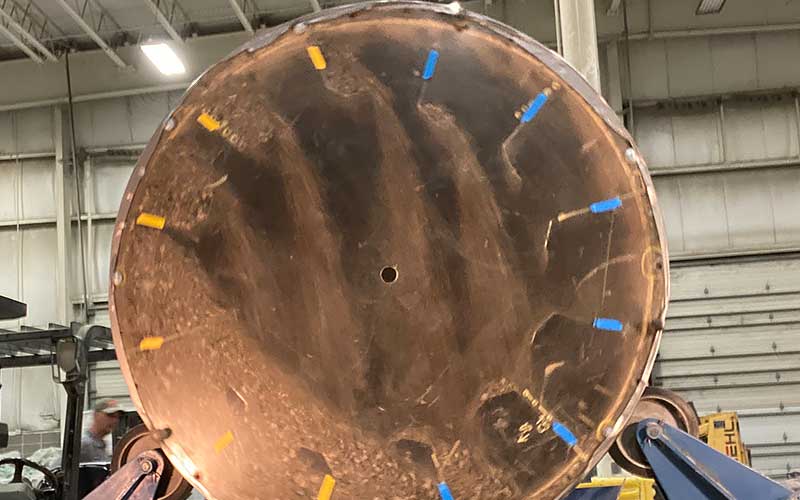
Flight simulator testing in progress
Retrofit A Combustion Chamber
While a combustion chamber may not be required in all settings, incorporating one onto an existing dryer can offer tangible results in energy savings thanks to a more complete combustion of fuel.
The incorporation of a combustion chamber also introduces the opportunity to use dilution air, which further improves system efficiency; when paired with dilution air, the combustion chamber allows for improved control over the process gas inlet temperature, which gives operators an enhanced ability to optimize the system.
The use of dilution air also leads to more uniform drying and provides an outlet for recovered waste heat.
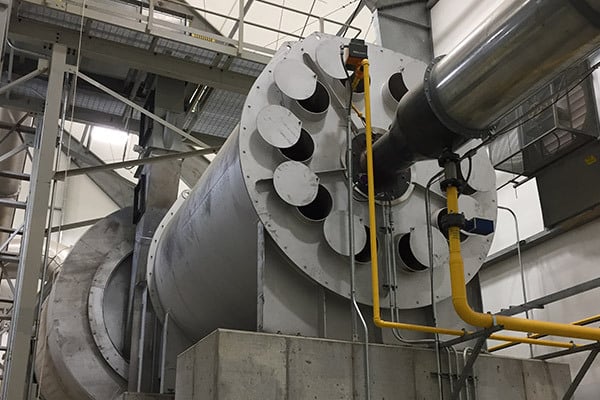
Rotary dryer combustion chamber with burner
In plants utilizing a cooler following the dryer, the combustion chamber offers an indirect path to energy savings as well, preventing contact between the material and burner flame, thereby lowering the energy burden on the cooler.
Replace the burner
Where a burner is fundamentally sound, air-fuel tuning (covered above) should be exhausted before replacement is considered. With that in mind, however, it’s important to recognize that burner technology continuously evolves, and even the most well-maintained burner designed 10 years may not be able to compete with today’s advanced systems. This is particularly evident in looking at excess air requirements. A burner that can reduce excess air requirements can reduce fuel input, equating to an annual savings, while at the same time lowering the system’s carbon footprint.
Upgrade Controls
Likewise, upgrading outdated controls systems can also bring energy savings. Most dryers offer controls to manage start-up and shutdown, but more advanced controls can automate operating parameters for maximum efficiency, moderating inlet temperature, feed rate, and airflow in real time. This can provide worthwhile savings compared to manual monitoring and adjustment.
Recover heat, where possible
Rotary dryers offer two avenues to reduce energy consumption via heat recovery: recovering heat from the dryer and employing it elsewhere in the plant, and recovering heat in other settings and using it to preheat combustion or dilution air going into the dryer.
In suitable settings, a rotary dryer retrofitted to capture exhaust heat and divert it for use in preheating dilution air can reduce fuel consumption by 5-10%.
Alongside controlling the air-fuel ratio to save on energy, the DOE acknowledges preheating of combustion air or feedstock as another important opportunity to reduce energy costs in process heating applications.3
Conclusion
The quiet accumulation of rotary dryer inefficiencies acquired through worn seals, drifting burner calibration, degraded flights, and habits that form around changed feed conditions are often inconspicuous, going unnoticed for long periods of time. These inefficiencies can only be gained back through targeted fixes and upgrades.
Addressing maintenance and operating issues by aligning the dryer with its original condition provides the quickest wins, with the potential for tangible savings.
Upgrades build on that foundation—an optimized curtain, a modern burner or combustion chamber, advanced controls, and heat recovery where the process allows, underpinned by a process audit to reveal where losses are actually occurring, will deliver the best return.
The gains compound for the life of the system. For a system evaporating 20,000 lb/hr of water, every 100 BTU/lb improvement is worth roughly $100,000 annually—savings delivered year after year, with a lower carbon footprint to match.
As the original equipment manufacturer with over 75 years of experience designing, building, and servicing rotary dryers, FEECO supports every stage of an efficiency program: process audits to find the losses, the FEECO Innovation Center to validate solutions with actual material, and parts and service to keep the system running as designed. To discuss improving the efficiency of your rotary dryer, contact us today!
SOURCES:
- Mujumdar, Arun S., ed. “Handbook of Industrial Drying.” 3rd edition, CRC Press, 2007. Google Books. Accessed Oct. 27, 2026.
- Ares-Sainz, José Luis et al. “Toward the Decarbonization of Industrial Drying Technologies: Cross-Sector Sustainability, Economics and Efficiency Integrated Assessments With Emphasis on the Wood and Paper Industries.” Environmental Technology & Innovation, Vol. 43, September 2026. ScienceDirect.. Accessed Oct. 27, 2026.
- “Improving Process Heating System Performance: A Sourcebook for Industry.” 3rd edition, U.S. Department of Energy, Office of Energy Efficiency and Renewable Energy, 2016. Accessed Oct. 27, 2026.

