Canada is rapidly emerging as a key player in the global lithium market, with two spodumene operations currently in production and a growing pipeline of projects in development.
Supported by favorable geology, government policy, and proximity to North American battery manufacturing, the country is positioning itself as a strategic supplier of this critical mineral.
Canada’s Push for Lithium
Like many nations, Canada began prioritizing domestic lithium production due to the essential role it will play in meeting growing demand for electric vehicles (EVs) and energy storage applications.
Despite being home to lithium resources, Canada currently imports the bulk of its lithium products, making it dependent on supply chains largely dominated by China. As such, the government has made several efforts to take advantage of its lithium-rich resources to build a domestic supply chain.
In 2021, Canada’s Minister of Natural Resources released the nation’s first-ever list of minerals designated as critical to the nation’s security and economic success, in which lithium was included.[A]
While the list has since been updated, lithium continues to remain, signaling it as a top priority for the nation and reaffirming the government’s desire to reduce the country’s dependence on increasingly unstable supply chains.
Canada then developed a critical minerals strategy to incentivize domestic (and global) production of critical minerals across the supply chain. Among many efforts, Canada prioritized lithium in the top six of its critical minerals list, as part of the strategy in an effort to streamline processes and increase opportunities around lithium.[C]
In 2024, the government’s efforts paid off when BloombergNEF announced that for the first time in the four-year history of their Global Lithium-Ion Battery Supply Chain Ranking, Canada ousted China, taking the top spot as a potential lithium-ion battery producer. The list evaluates 30 countries, ranking them according to their ability and potential to build a secure and sustainable lithium-ion battery supply chain. The announcement noted:[B]
“Canada’s consistent manufacturing and production advances and strong ESG credentials have helped it become a leader in forming the battery supply chains of the future. Strong integration with the US automotive sector means Canada is also a big winner of the ‘friendshoring’ ambitions of the US Inflation Reduction Act. Canada’s position in the 2024 ranking is propelled by policy commitment at both the provincial and federal level.”
Canada’s Pegmatite/Spodumene Resources
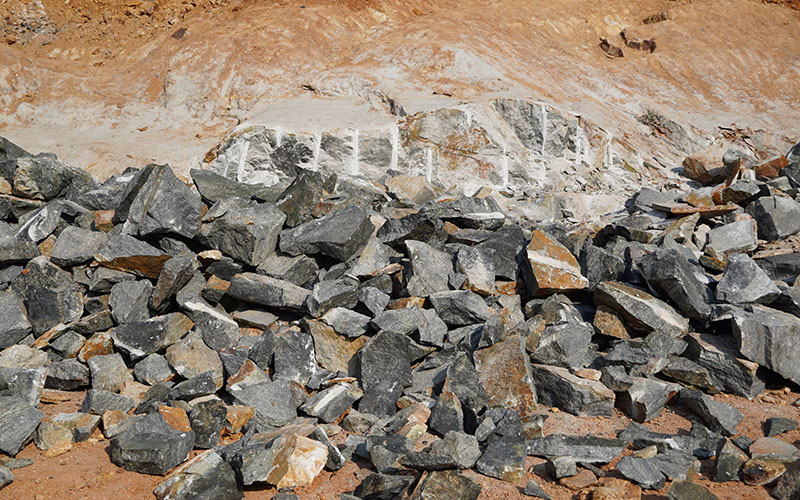
With a number of hard rock pegmatite deposits, which are the primary source of lithium minerals (most notably spodumene), Canada is well positioned to make its lithium ambitions a reality. The nation houses an estimated 3.2 million tons of lithium oxide resources held in hard rock deposits.[F]
Currently two major spodumene operations are producing lithium and positioning Canada amongst the top 15 global suppliers:
[D]
The James Bay (Galaxy) Project
The former James Bay project, now known as the Galaxy project, was recently acquired by Rio Tinto as part of their acquisition of Arcadium Lithium. The project held 8th place for estimated production levels at the end of 2024, with a projected forecast of 57,621 tons of lithium carbonate equivalent (LCE) production, according to data gathered by Canadian Mining Journal.
The project is located in the James Bay region of Québec in what the industry has deemed the “Québec Lithium District.”
The North American Lithium (NAL) Project
Also known as La Corne or Québec Lithium, the North American Lithium (NAL) project was 13th in estimated LCE production at 31,078 tons. NAL is owned by Elevra Lithium (a merger of Sayona Mining and Piedmont Lithium) and is also located in Québec.
Other Notable Pegmatite Projects
Beyond the projects currently contributing to production, Canada hosts a broad pipeline of advanced and emerging pegmatite developments that could significantly expand future supply.
Tanco
Location: Bernic Lake, Manitoba (in the Winnipeg River-Cat Lake pegmatite field)
Owner: Sinomine Rare Metals Resources
Stage: Operating
Why it’s Notable: The Tanco project is a well-known lithium-cesium-tantalum (LCT) mine that’s been in operation since 1969 and continually increasing production. It is primarily situated under Bernic Lake, and for this reason, is also known as the Bernic Lake Mine.
Shaakichiuwaanaan
Location: James Bay region of Québec
Owner: PMET Resources (formerly known as Patriot Battery Metals)
Stage: Feasibility
Why it’s Notable: Shaakichiuwaanaan is recognized as the largest lithium pegmatite resource in the Americas and among the top ten globally, representing a tier-one undeveloped hard-rock lithium asset.
Whabouchi
Location: James Bay region of Québec
Owner: Nemaska Lithium
Stage: Advanced development
Why it’s Notable: Whabouchi is recognized as a “world-class” spodumene deposit.
Rose Lithium-Tantalum Mine
Location: James Bay region of Québec
Owner: Critical Elements Lithium Corporation
Stage: Feasibility
Why it’s Notable: The Rose Lithium-Tantalum Mine hosts a high-purity spodumene deposit with the potential to yield tantalum as a co-product.
Moblan
Location: James Bay region of Québec
Owner: Elevra Lithium (a merger of Piedmont Lithium and Sayona Mining)
Stage: Advanced development
Why it’s Notable: A large-scale development, once operational, Moblan could become a major supplier of lithium concentrate.
Authier Lithium Project
Location: Near Val-d’Or, Québec
Owner: Elevra (a merger of Piedmont Lithium and Sayona Mining)
Stage: Advanced development
Why it’s Notable: A major spodumene deposit situated near Val-d’Or, Québec, Authier is strategically located near the already-in-production North American Lithium project, offering potential benefits to operational and infrastructure requirements.
Adina Lithium
Location: James Bay region of Québec
Owner: Winsome Resources
Stage: Exploration/Early development
Why it’s Notable: The Adina Project is backed by a promising preliminary economic assessment (PEA).
PAK Lithium
Location: Northwestern Ontario
Owner: Frontier Lithium
Stage: Definitive Feasibility
Why it’s Notable: PAK Lithium contains the highest-grade lithium resource in North America and is the continent’s second largest in size.
Seymour
Location: Ontario
Owner: Green Technology Metals
Stage: Late-stage development
Why it’s Notable: The Seymour Project is one of Ontario’s most advanced pegmatite projects and continues to advance toward construction with key mining leases in place.
Separation Rapids
Location: Near Kenora, Ontario
Owner: Separation Rapids (a joint venture between SCR-Sibelco NV and Avalon Advanced Materials Inc.)
Stage: Development
Why it’s Notable: Separation Rapids is unique in that it not only hosts spodumene, but also lepidolite and the more rare mineral petalite, enabling the mine to serve not only the battery supply chain, but the glass-ceramics market as well.

Canada’s Lithium Brines
While lithium production in Canada is largely centered around the nation’s extensive hard rock resources, it’s important to note that brine deposits are also being explored, particularly as technologies in direct lithium extraction (DLE) advance.
Though still early-stage in Canada, these resources could introduce new opportunities, and new processing challenges, as technologies and economics evolve.
Notable Brine Projects
Park Place
- Location: Alberta, Canada
- Owner: LithiumBank
- Stage: Resource definition/Development
- Why it’s Notable: Park Place holds one of North America’s largest NI 43-101 inferred lithium brine resource estimates.
Clearwater
- Location: Alberta (Leduc Formation; Clearwater/Bashaw area)
- Owner: E3 Lithium
- Stage: Advanced development
- Why it’s notable: Clearwater is one of Canada’s most advanced lithium brine projects, with published NI 43-101 resources and active piloting of DLE technologies aimed at commercial-scale production.
Boardwalk
- Location: Alberta (Leduc Formation; Clearwater/Bashaw area)
- Owner: LithiumBank
- Stage: Advanced development
- Why it’s notable: Boardwalk is reported by LithiumBank to be Alberta’s highest-grade measured and indicated lithium brine resource.
Prairie Lithium
- Location: Southeastern Saskatchewan
- Owner: Prairie Lithium (Arizona Lithium)
- Stage: Development
- Why it’s notable: Prairie Lithium is a leading Saskatchewan project and the first brine project in the province to receive approval from the Ministry of Energy and Resources.
Kindersley Lithium Project
- Location: Southwest Saskatchewan
- Owner: Grounded Lithium Corp.
- Stage: Development
- Why it’s notable: Kindersley is recognized as one of the most prominent Saskatchewan brine projects with NI 43-101 technical reporting and published economic study material (PEA), plus ongoing work toward a PFS.
Conclusion
As Canada continues to advance its lithium ambitions—from exploration-stage pegmatites to producing mines and downstream battery supply chains—processing and materials handling will play a central role in determining which projects successfully reach commercial production.
Across hard-rock lithium operations, producers face common challenges: managing abrasive ores, achieving consistent concentrate quality, drying and thermal treatment of intermediates, and handling large volumes of bulk material reliably and efficiently. These challenges underscore the importance of proven process design, robust equipment, and early-stage testing to reduce risk as projects scale.
With decades of experience supporting mining and mineral processing operations, FEECO works with lithium producers at every stage of development, providing feasibility testing, custom process equipment such as rotary dryers, kilns, and agglomeration systems, and the bulk material handling solutions required to move product through the plant. Through pilot-scale testing in the FEECO Innovation Center and custom-engineered equipment built for demanding applications, FEECO helps lithium projects translate promising resources into commercially viable operations. For more information on testing or custom lithium processing equipment, contact us today!